Agile Development
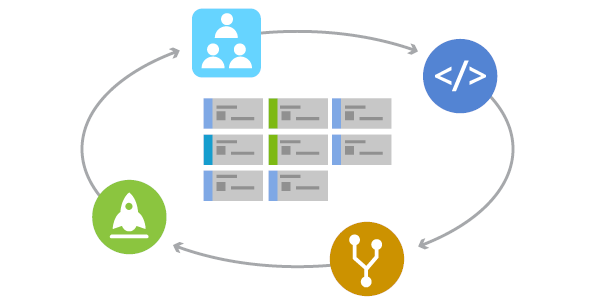
Agile is a set of principles and practices for software development that emphasize incremental delivery, team collaboration, continual planning, and continual learning. The term Agile was coined in 2001 in the Agile Manifesto, which established four core values:
- Individuals and interactions over processes and tools
- Working software over comprehensive documentation
- Customer collaboration over contract negotiation
- Responding to change over following a plan
The manifesto doesn’t imply that the items on the right are unimportant, but that the items on the left are more highly valued.
Agile in 2025: Latest Practices
- DevOps Integration: Agile and DevOps are now tightly coupled. Teams use CI/CD pipelines (e.g., GitHub Actions, Azure Pipelines) to automate testing, deployment, and feedback loops.
- Cloud-Native Delivery: Agile teams leverage cloud platforms (AWS, Azure, GCP) for rapid provisioning, scaling, and experimentation.
- AI & LLMs in Agile: Large Language Models (LLMs) like GitHub Copilot and Claude are used for code generation, documentation, and backlog grooming.
- Remote & Hybrid Collaboration: Tools like Azure DevOps, Jira, and Slack support distributed Agile teams with real-time boards, async standups, and automated notifications.
- Continuous Feedback: Automated monitoring, feature flags, and A/B testing enable rapid learning and adaptation.
Real-Life Example: Agile Sprint with DevOps
- Backlog Refinement:
- Product Owner and team use Azure Boards to prioritize user stories.
- Sprint Planning:
- Engineers estimate tasks and define acceptance criteria.
- Development:
- Code is committed to GitHub; Copilot suggests code and tests.
- CI pipeline runs tests and builds Docker images.
- Deployment:
- Azure Pipelines deploys to a Kubernetes cluster (AKS).
- Review & Retrospective:
- Team reviews metrics (e.g., deployment frequency, lead time) and discusses improvements.
Best Practices (2025)
- Keep feedback loops short—automate testing and deployment.
- Use Infrastructure as Code (Terraform, Bicep) for reproducible environments.
- Integrate LLMs for documentation, code review, and backlog management.
- Foster psychological safety for open communication and experimentation.
- Measure outcomes (not just outputs): focus on customer value and business impact.
Common Pitfalls
- Over-reliance on tools without team collaboration.
- Neglecting technical debt and refactoring.
- Failing to adapt processes as the team or product evolves.