Synechron ARC — Multi-Cloud Compliance Pipeline
The compliance pipeline platform that runs the same way on AWS, Azure, GCP, and a laptop.
Synechron ARC (internally SARC) is a customer demo and reference platform that wires ServiceNow + Fides + GitLab / GitHub / Azure DevOps into a single, auditable delivery pipeline — deployable to AWS EKS, Azure AKS, GCP GKE, or local k3d from one repository with a single TARGET_CLOUD environment variable. OpenShift (ROSA HCP) is a fifth, read-only observable target inside the portal.
The deployable workload is the CNCF podtato-head microservice mesh; the value is the compliance pipeline around it — and the ARC-portal, a Next.js DevSecOps control plane that stitches every signal (CI status, scans, change requests, SBOMs, Fides attestations, CMDB CIs, costs, AI guardrails) into one screen.
At a glance
| Role | Lead engineer, architect, full-stack |
| Status | Active customer demo platform; mirrored across GitLab / GitHub / Azure DevOps |
| Clouds | AWS (EKS 1.31), Azure (AKS 1.31), GCP (GKE 1.31), local k3d, OpenShift (ROSA HCP, read-only) |
| CI | GitLab (source of truth), GitHub Actions (full parity), Azure Pipelines (in progress) |
| Portal stack | Next.js 15, TypeScript, Prisma, Postgres, Redis, multi-provider LLM |
| Compliance | SOC 2, SOX, PCI DSS, ISO 27001, DORA Regulation, NIST 800-53 |
| License | Apache-2.0 |
The problem ARC solves
Regulated organisations hit the same four problems with software delivery:
- Evidence is scattered across SonarQube, Snyk, Wiz, GitGuardian, ServiceNow, and three CI systems. An auditor asks one question and someone spends a week in spreadsheets.
- Approvals are a bottleneck. A typo fix and a schema migration get the same 48-hour CAB review. Engineers route around the system; auditors lose the trail.
- CMDB is always stale. By month-end it bears no resemblance to reality.
- Cloud lock-in is forced early because compliance tooling is built around one cloud’s primitives. Evaluating a second cloud means rebuilding the pipeline.
ARC answers all four with a single pipeline that produces the same evidence on every cloud, and a single portal that surfaces that evidence — plus the controls that satisfy each framework — for every role in the delivery chain.
Architecture at a glance
                +-----------------------------------------+
                |              Developer push             |
                +-------------------+---------------------+
                                    |
                                    v
            +-----------------------+--------------------------+
            |   GitLab CI  (source of truth)                   |
            |   ----------                                     |
            |   validate  ->  build  ->  scan  ->  attest      |
            |                                       |          |
            |                                       v          |
            |                                  +---------+     |
            |                                  |  Fides  |     |
            |                                  +----+----+     |
            |                                       |          |
            |                  +----------+         |          |
            |   ServiceNow CR  | risk eval|<--------+          |
            |   <------------+ +----------+                    |
            +----------+--------+--+--------------------+------+
                       |           |                    |
                       |           |  mirror jobs       |
                       |           v                    |
                       |   +-----------+   +---------------------+
                       |   | GitHub    |   | Azure DevOps        |
                       |   | Actions   |   | Pipelines           |
                       |   +-----------+   +---------------------+
                       |
                       v
          +-------------------------------------+
          |  helm upgrade --values              |
          |  apps/<chart>/values-${CLOUD}.yaml  |
          +--+----------+----------+----------+-+
             |          |          |          |
             v          v          v          v
          +------+   +------+   +------+   +------+
          | EKS  |   | AKS  |   | GKE  |   | k3d  |
          +--+---+   +--+---+   +--+---+   +--+---+
             |          |          |          |
             +----------+----+-----+----------+
                            |
                            v
                   +-----------------+
                   |   ARC-portal    |
                   | (every signal)  |
                   +-----------------+
Every box on the path emits a Fides attestation, every promotion creates a ServiceNow change request, and the ARC-portal subscribes to all of it and renders the unified picture.
The one knob — TARGET_CLOUD
A single environment variable drives every cloud-specific decision:
export TARGET_CLOUD=aws # or azure | gcp | k3d
| Consumer | What it selects |
|---|---|
terraform -chdir=infra/${TARGET_CLOUD} |
Which cluster + identity stack runs |
configure-kubectl CI step |
Which cloud CLI authenticates kubectl |
helm upgrade --values apps/<chart>/values-${TARGET_CLOUD}.yaml |
Which cloud-specific overlay applies — ingress class, TLS issuer, external-secrets backend, managed-identity annotation |
| Fides environment name | ${TARGET_CLOUD}-karc-${env} — 12 environments across 4 clouds, all feeding one flow karc-pipeline |
What stays identical across clouds: ingress-nginx, cert-manager, external-secrets, the same Helm charts, the same just recipes, the same kubectl commands during a demo. What diverges, by necessity: identity federation (IRSA / Workload Identity / WI Federation), secret-store backend, managed Postgres + Redis, network primitives.
The ARC-portal — DevSecOps control plane
One web application, every role: developers, security, compliance, change managers, and management all open the same URL. Below is a tour of the surfaces that matter most.
Dashboard — release-health command centre
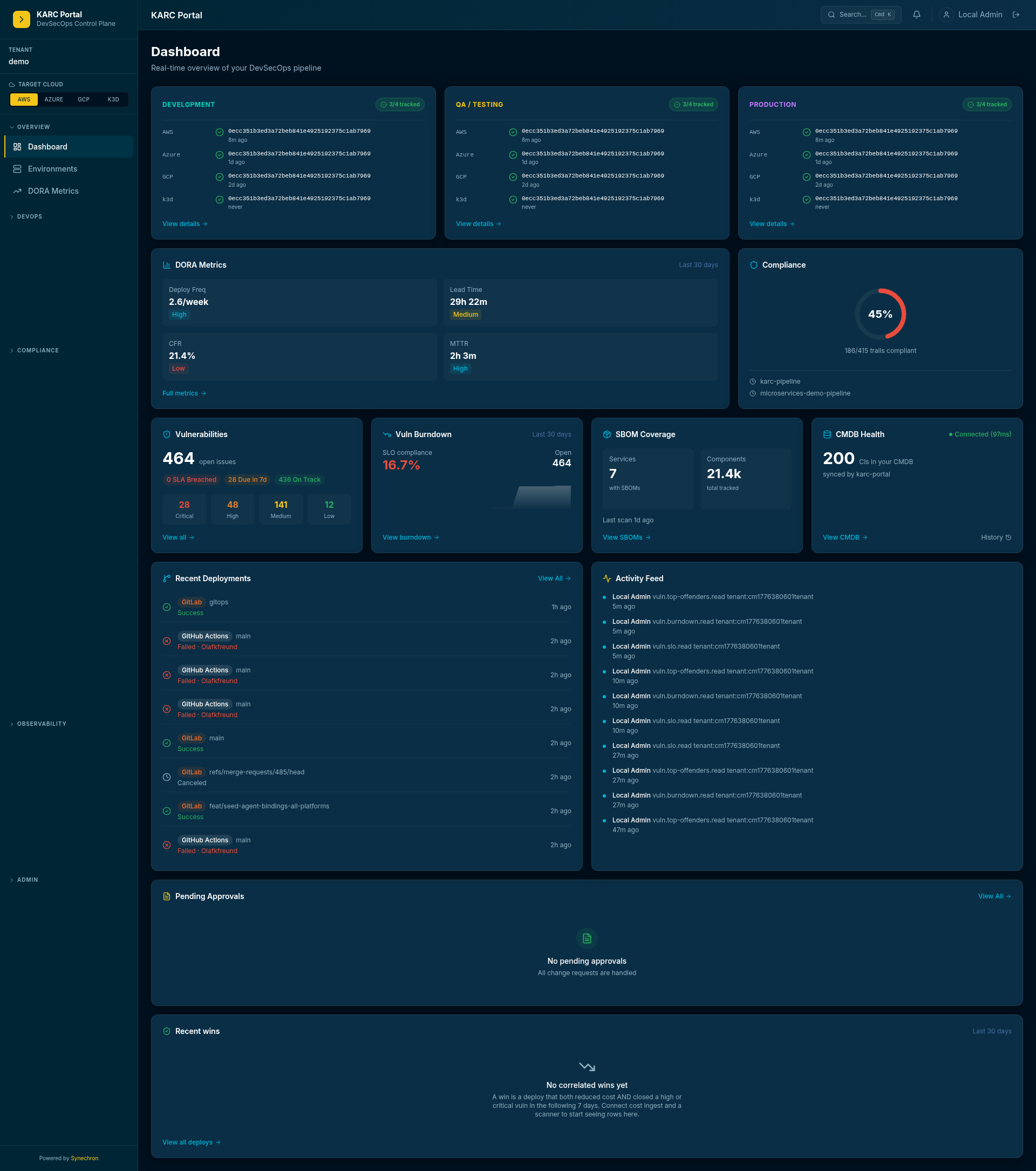
Per-environment status, DORA mini, pending change requests, deploy impacts, vulnerability burndown sparkline, SBOM coverage, and a change-window banner that turns red during freezes. One screen.
Environments and DORA metrics
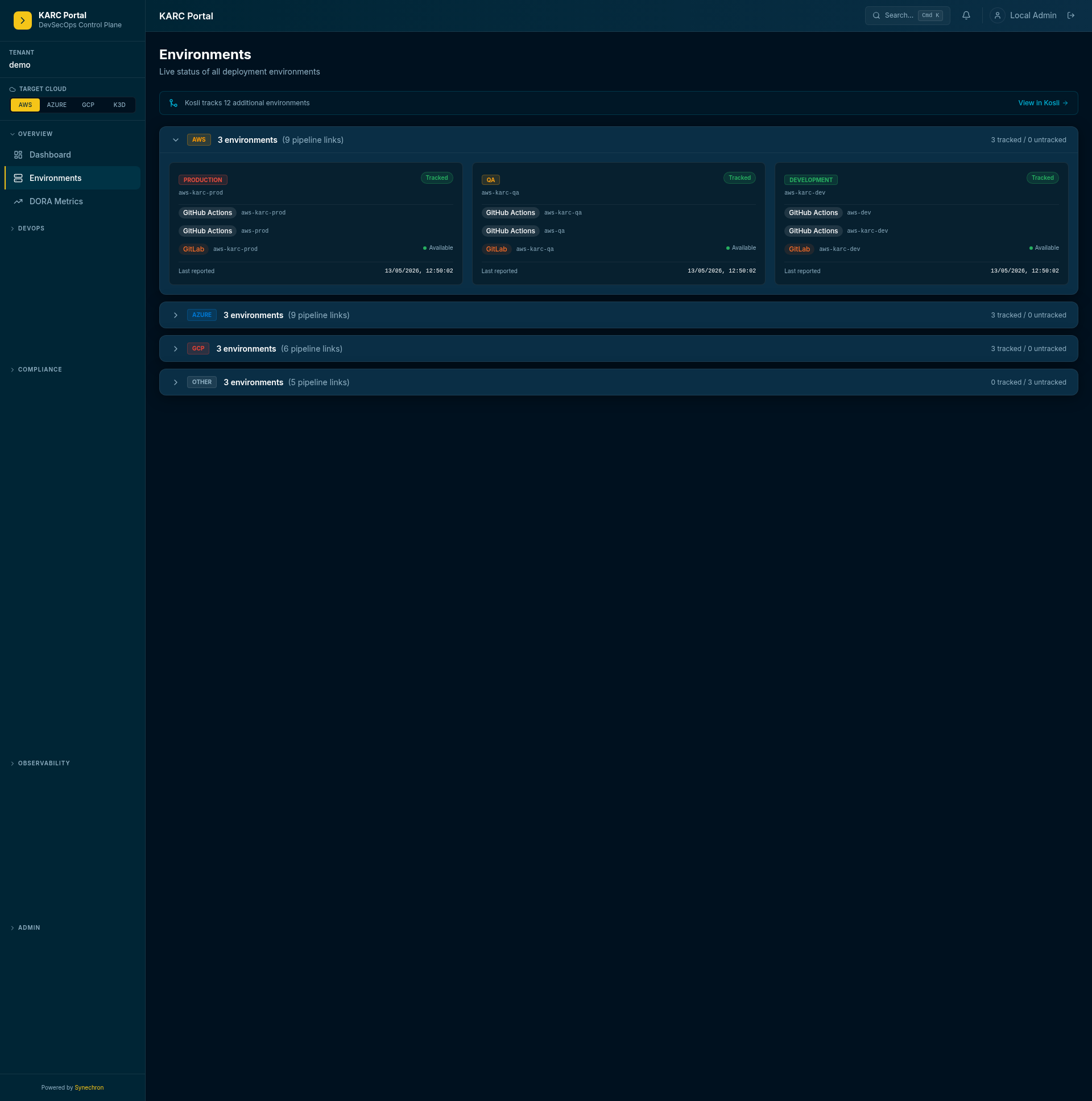
Every environment (dev / qa / prod) on every cloud with deployed services, current versions, and compliance status. Version drift between environments is visible at a glance.
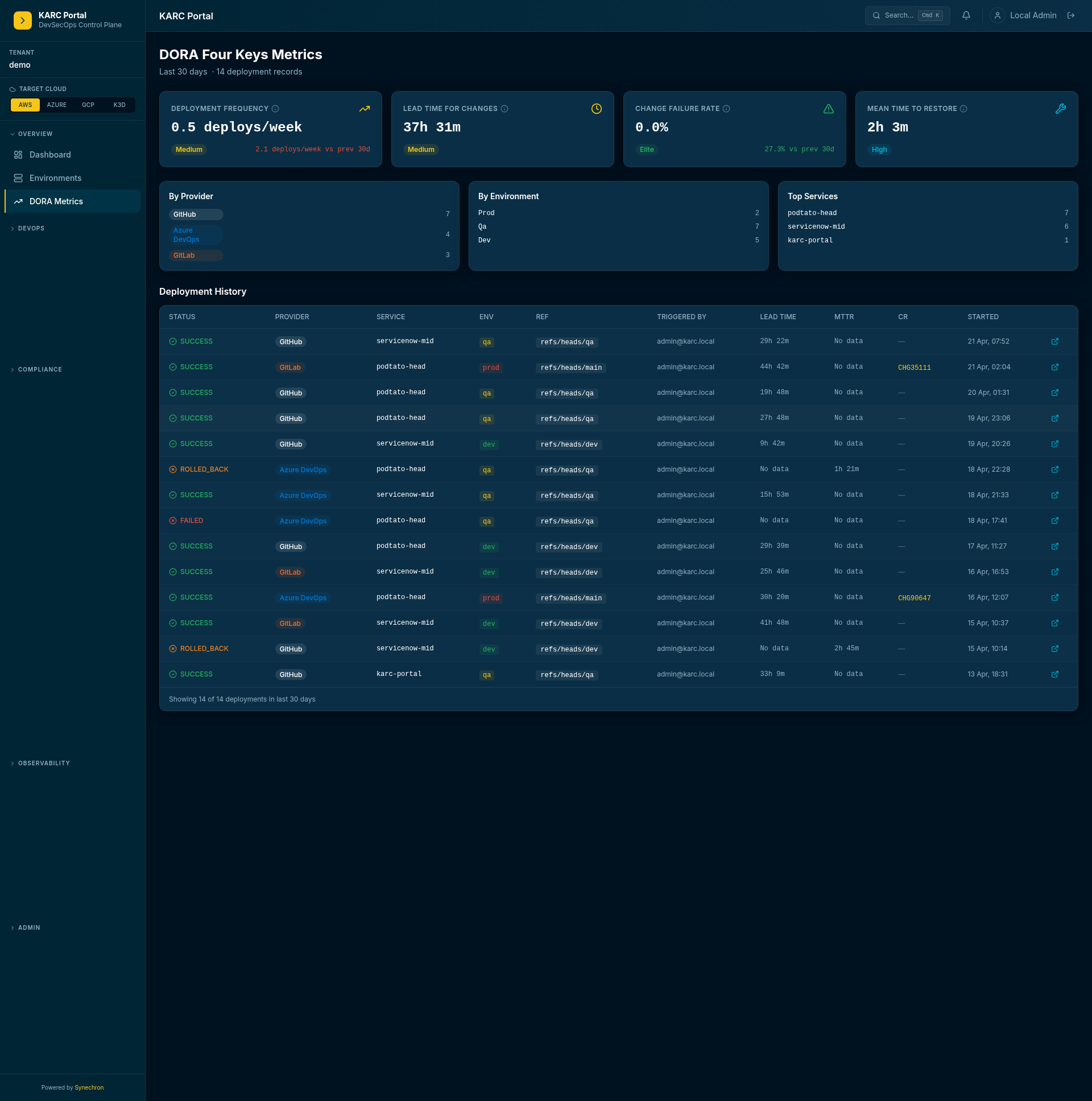
Deployment Frequency, Lead Time for Changes, Change Failure Rate, MTTR — calculated from pipeline data with trends over time.
Pipelines, change requests, and change windows
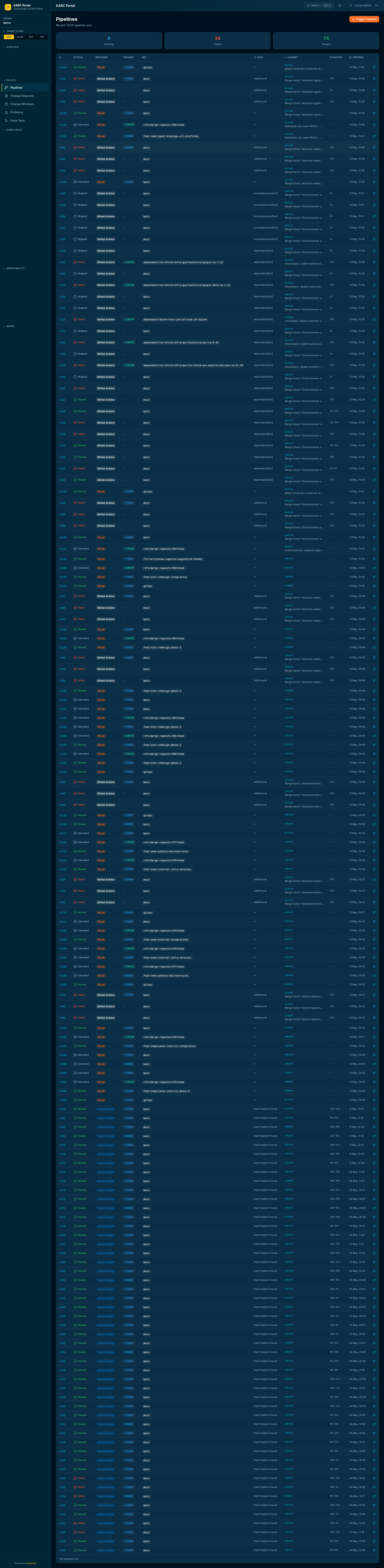
Every pipeline run across every connected CI/CD system (GitLab, GitHub Actions, Azure Pipelines) in one list with status, trigger, scans, and deep-link back to source.
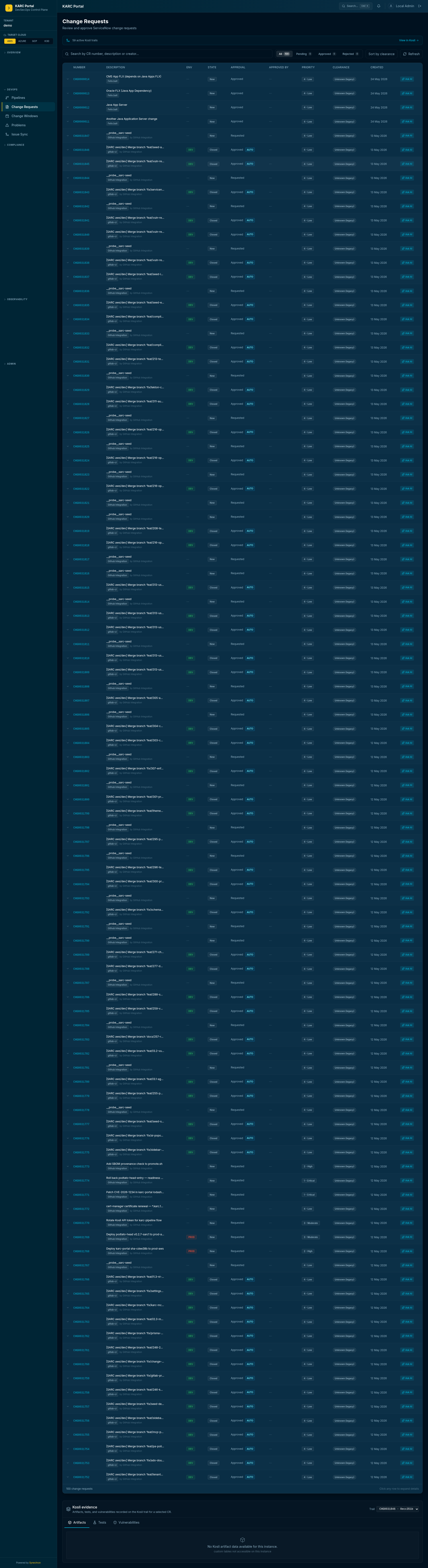
ServiceNow change requests created automatically by the pipeline, with risk score, approval status, and outcome. Risk-based routing: about 80% of releases need no manual approval.
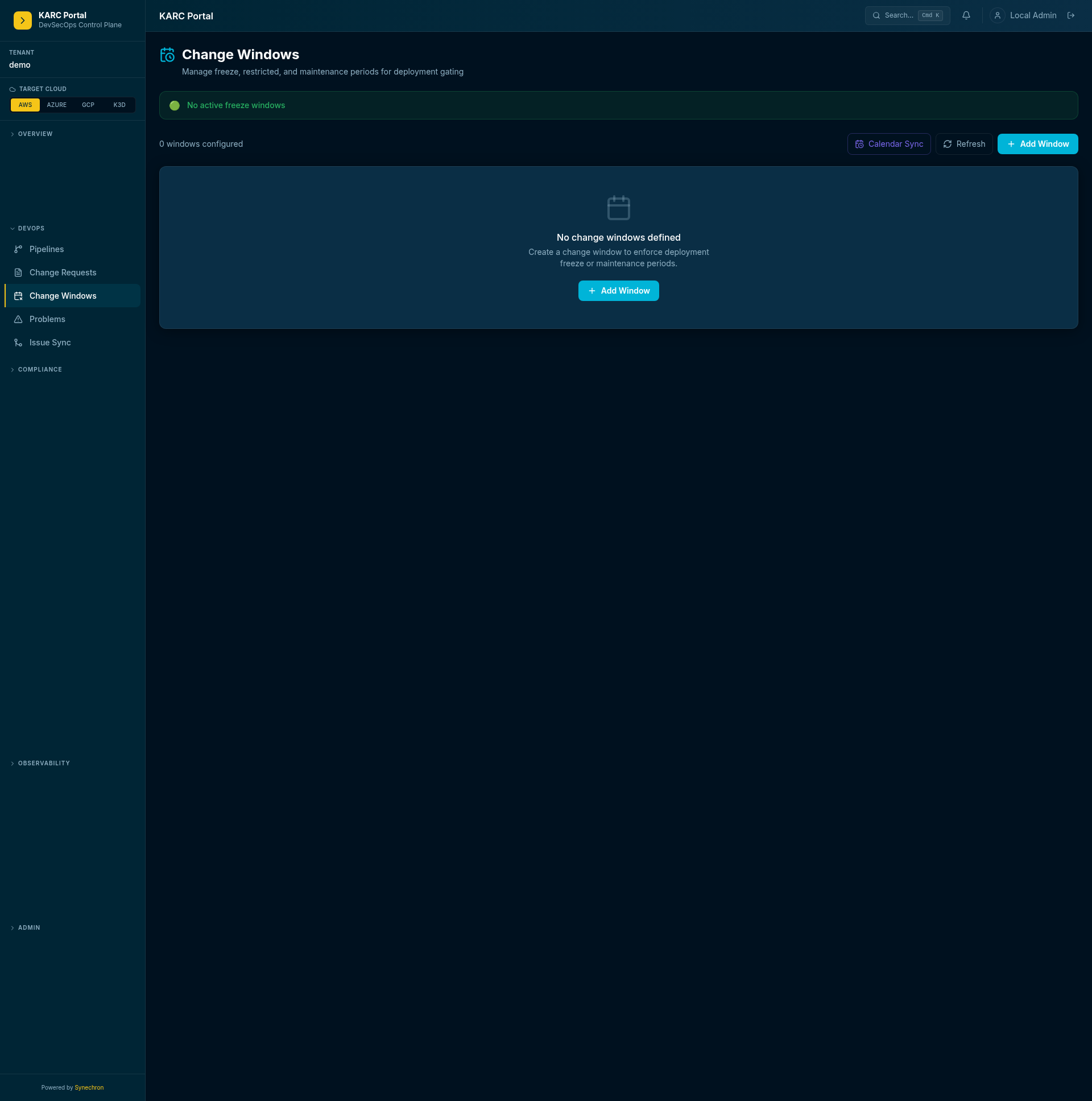
Freeze, restricted, or maintenance windows — one-time or recurring. Pipelines that try to deploy during a freeze are stopped before they touch the cluster.
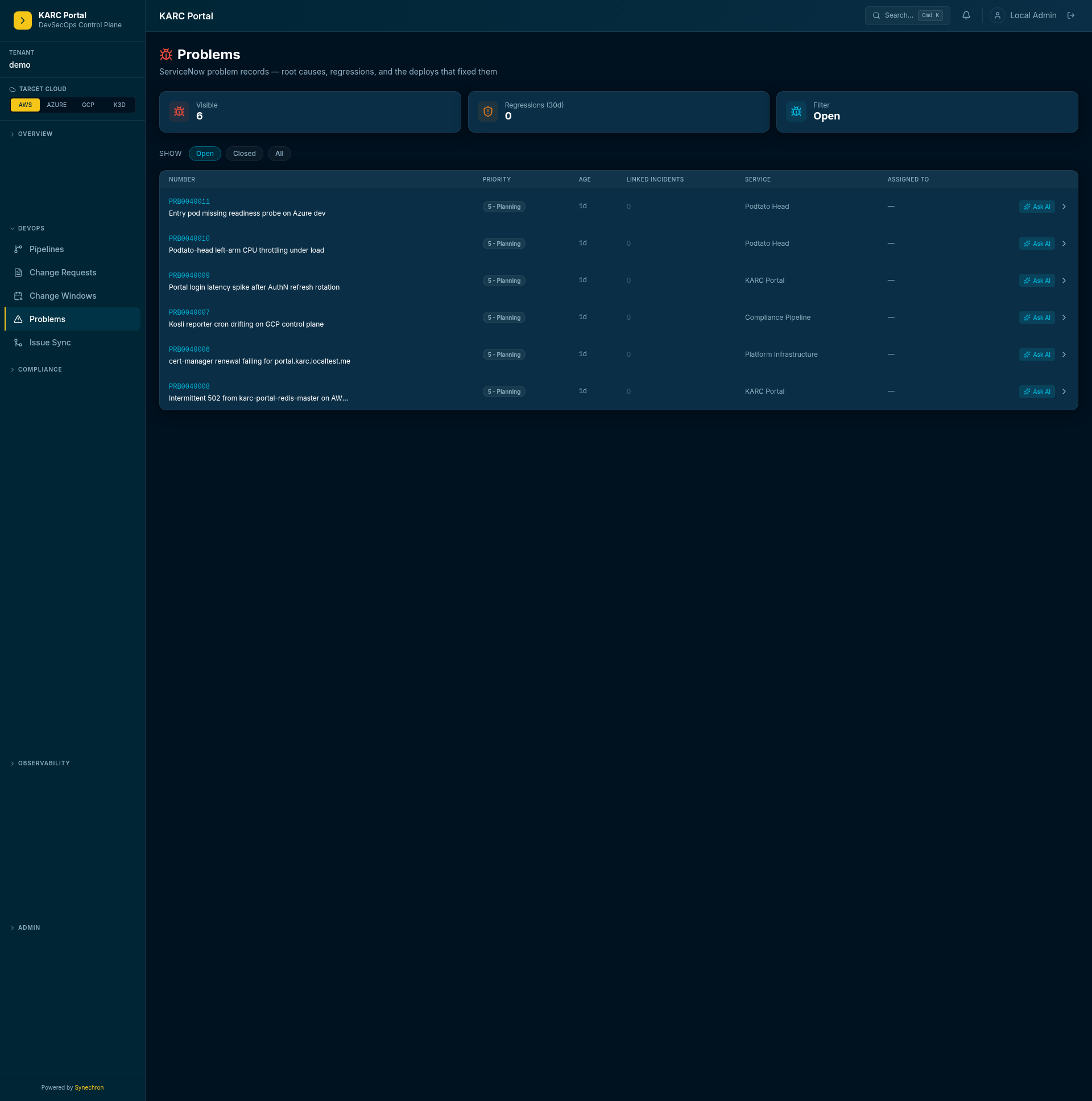
ServiceNow Problem records correlated with affected services and CIs, with one-click “Solve with Agent” dispatch.
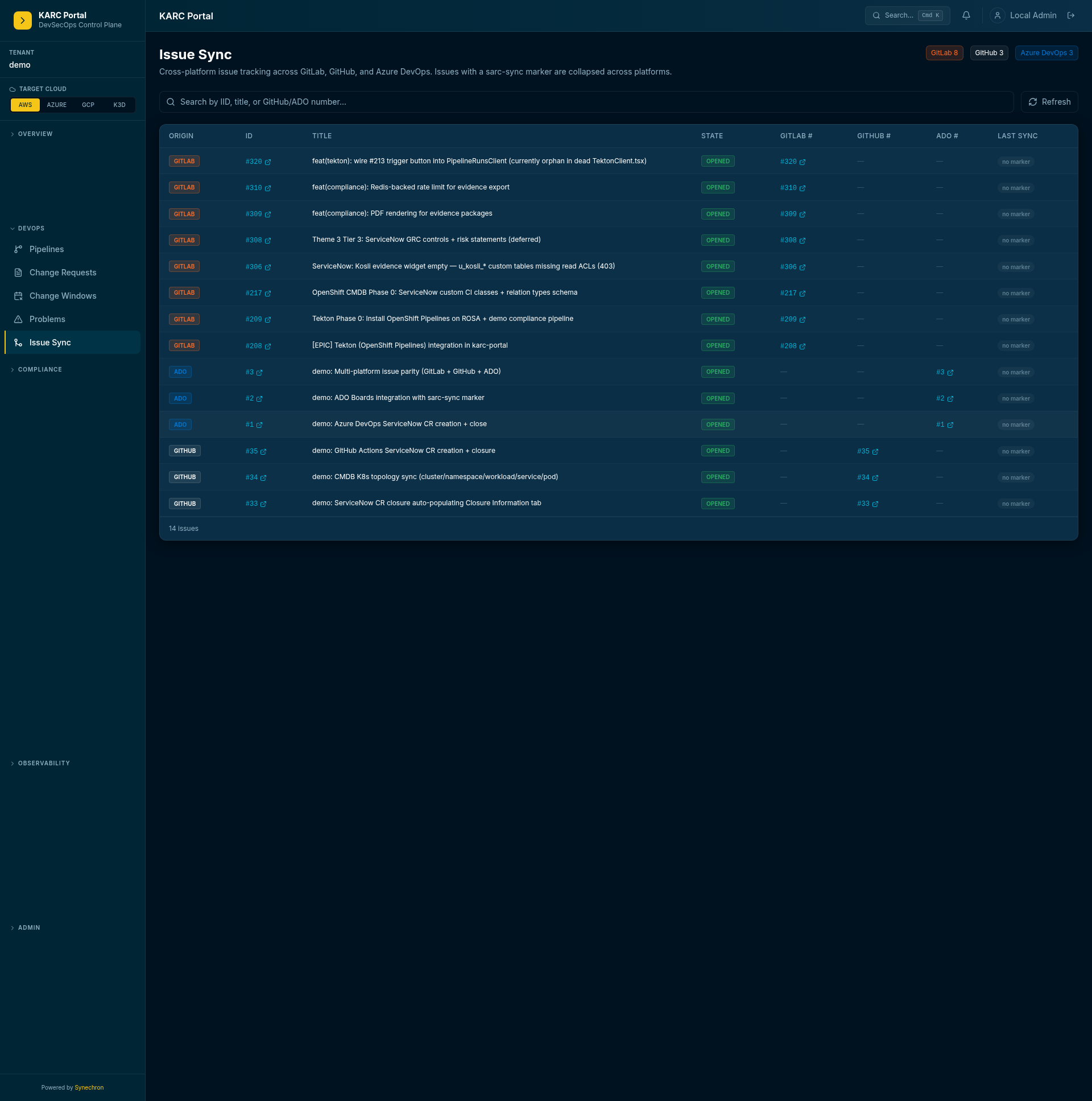
Three-way issue broker — GitLab Issues, GitHub Issues, and ADO Work Items kept in sync, with canonical-source tracking and state/label/comment replication.
Service catalogue, graph, and teams
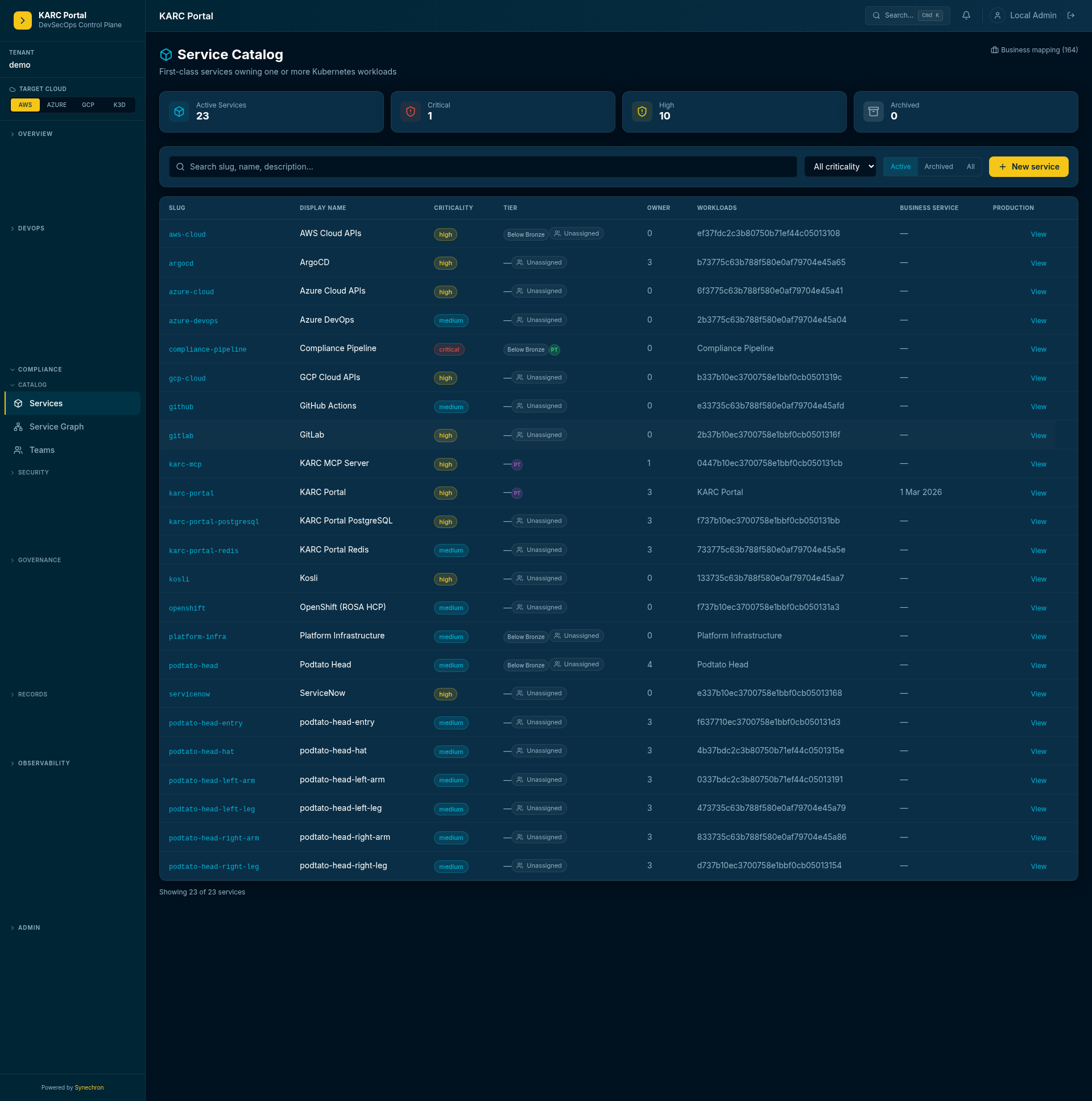
Every service indexed with owner, lifecycle, environment coverage, dependencies, and last-deployed metadata.
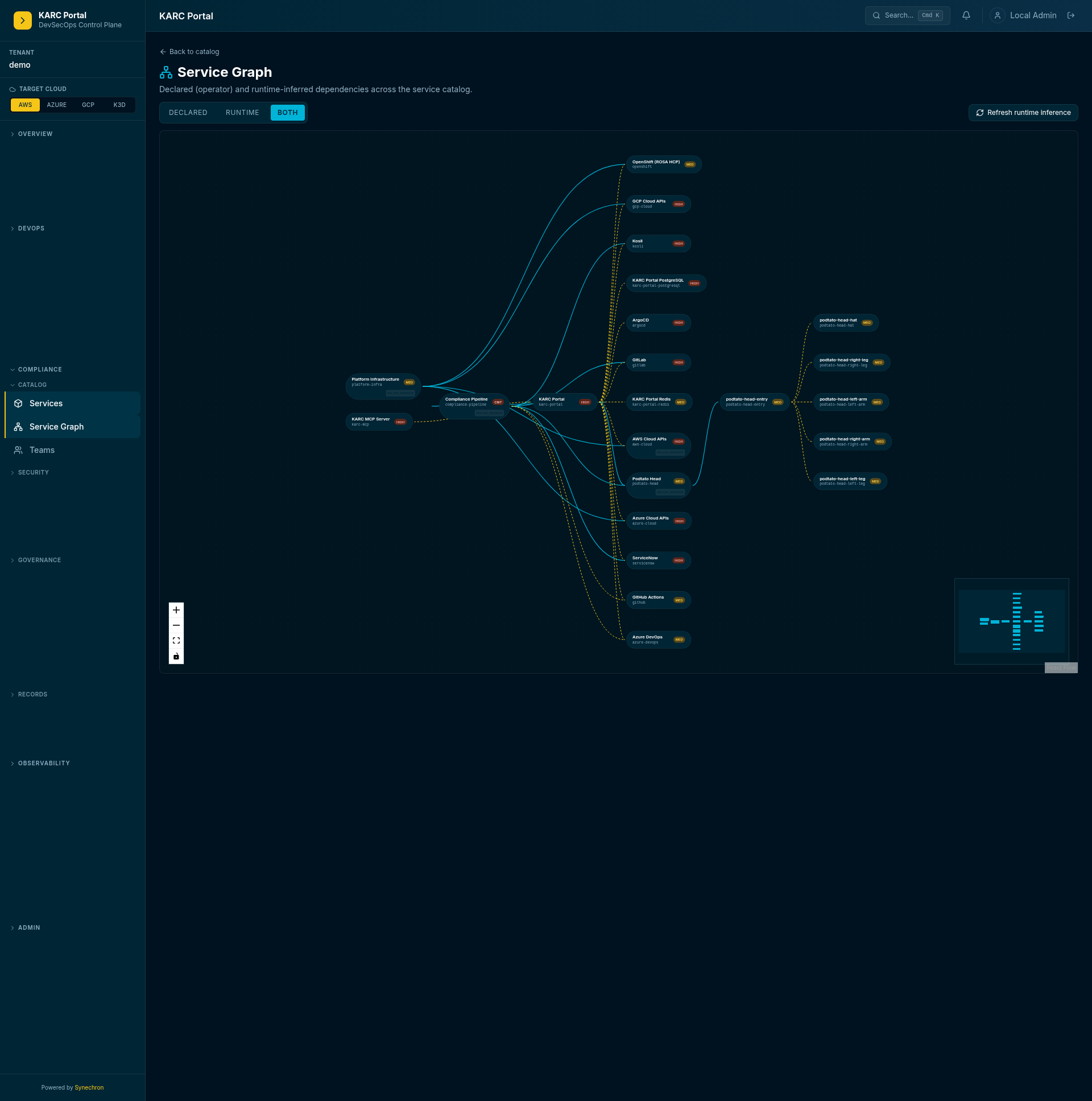
23 seeded services laid out as a force-directed graph — ARC internal infra (portal, MCP server, postgres, redis, argocd), the podtato microservice mesh, and 9 external integrations.
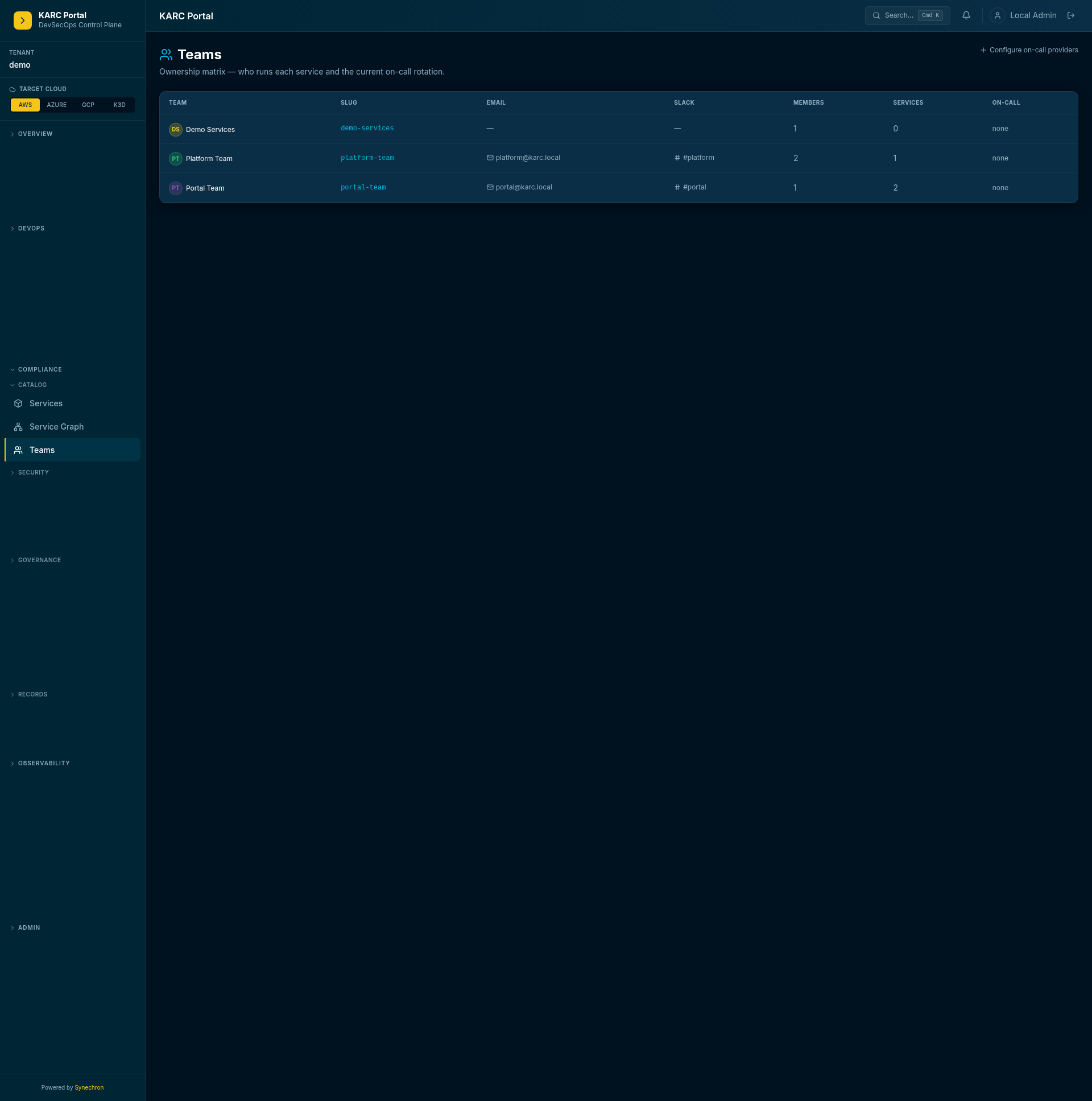
Team-to-service ownership with on-call rotation, escalation policy, and contact channels.
SBOMs, vulnerabilities, and security scans
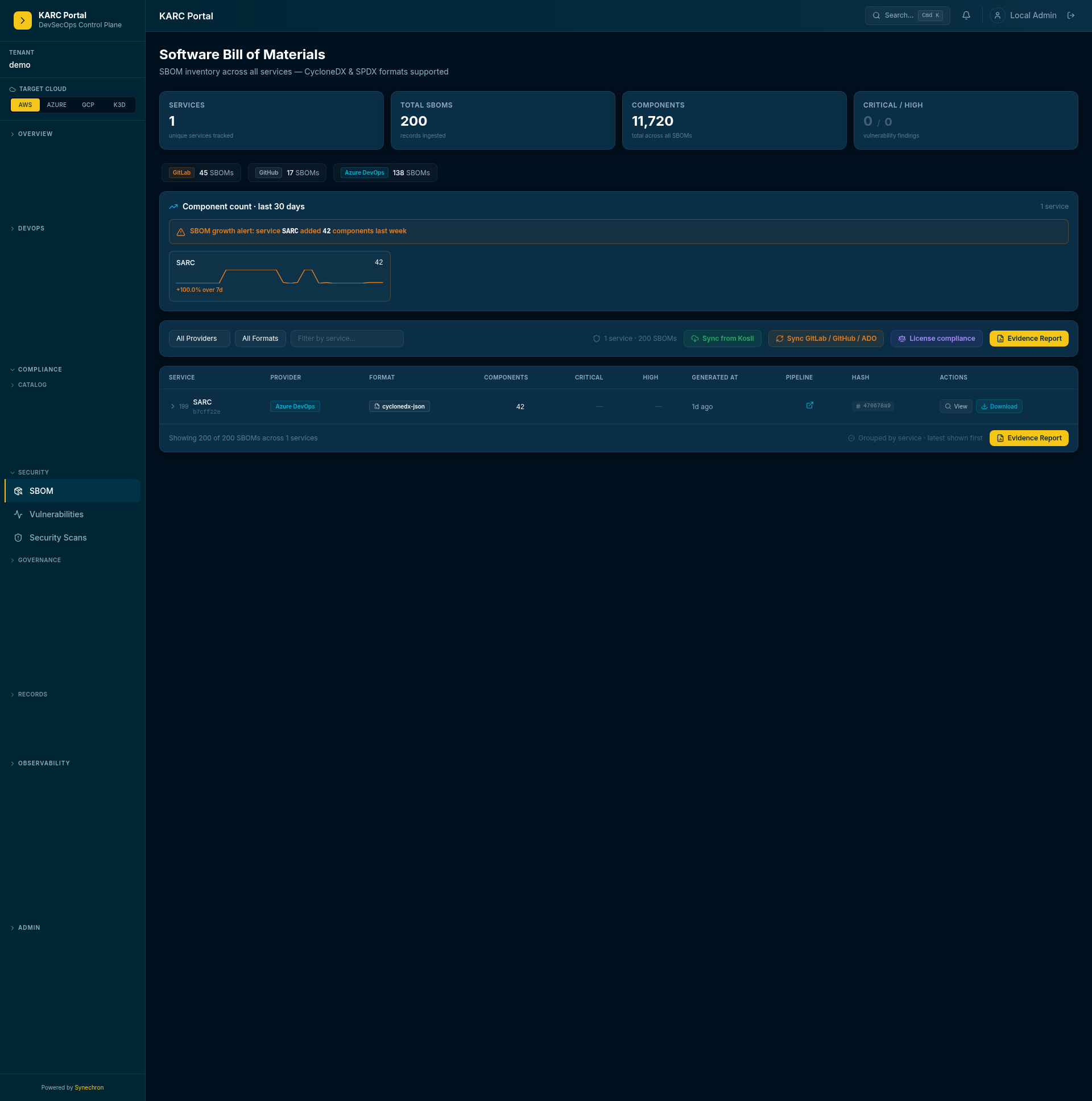
Complete component inventory per deployed service, CycloneDX + SPDX, SHA-256 verified, one-click download.

7-column tracked view with SLA folded into one cell (Critical 15d / High 30d / Medium 60d / Low 90d), priority KPI tiles, URL-persisted filters, and a row drawer with CVE/NVD/OSV advisory links, SBOM component, Fides attestation, AskAi popover, agent-fix dispatch, and impacted compliance controls.
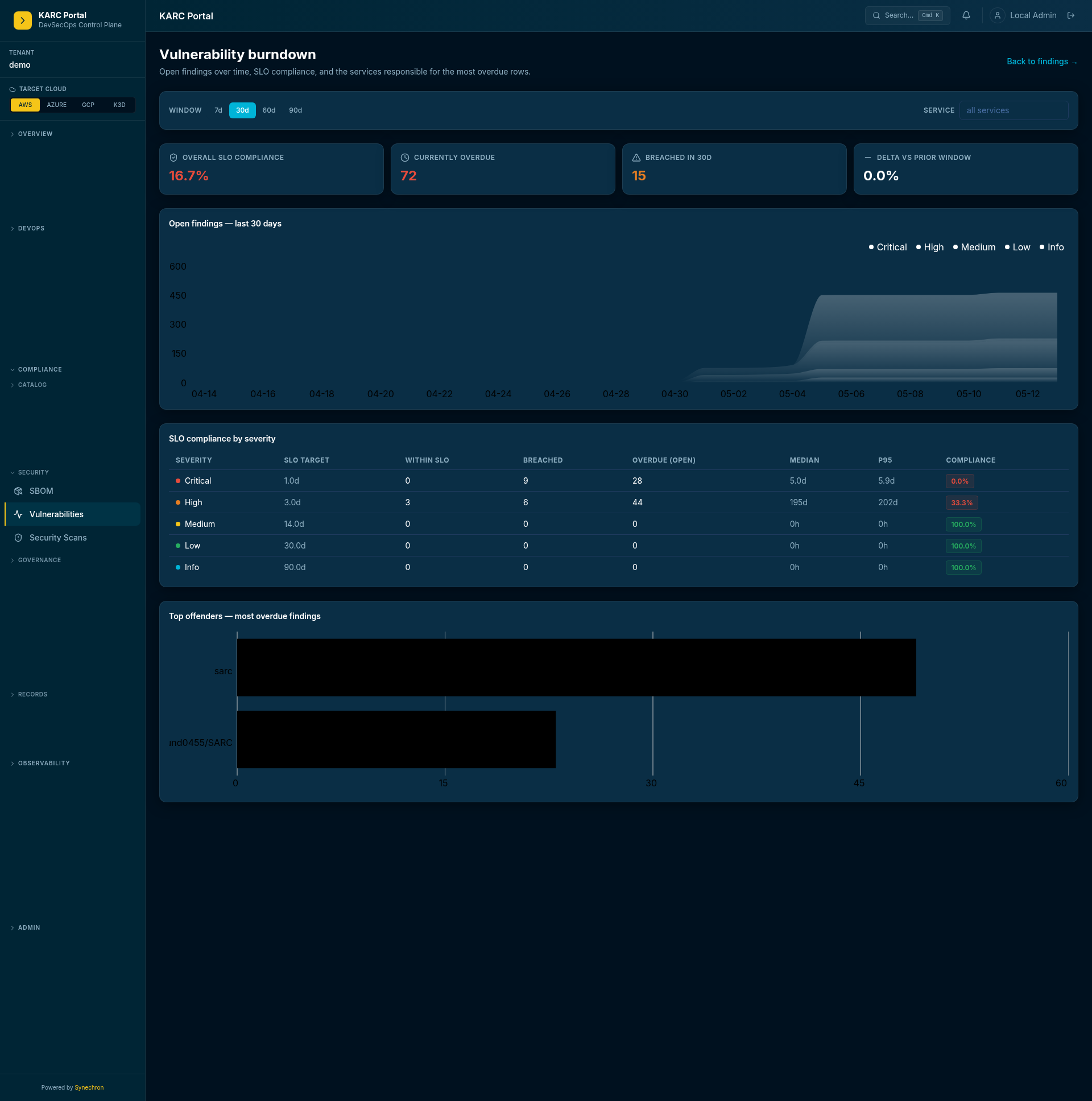
Severity-stacked burndown chart with SLA-breach overlay.
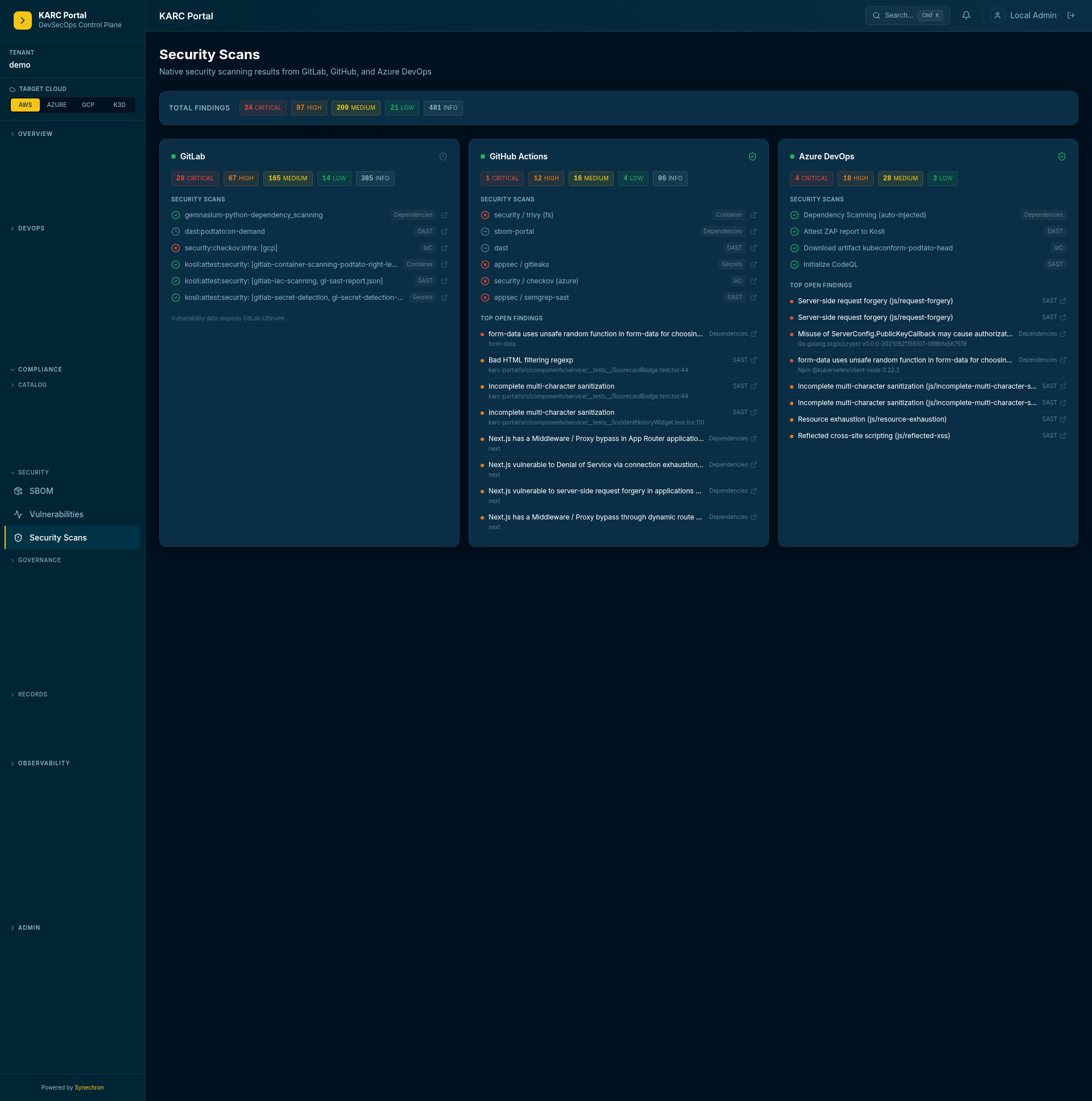
SAST, dependency, container, secret, IaC, and DAST findings aggregated from GitLab, GitHub Advanced Security, SonarQube, Snyk, Wiz, and GitGuardian. Six providers, one dashboard.
Compliance, risk, control mapping, policies, Fides, evidence export
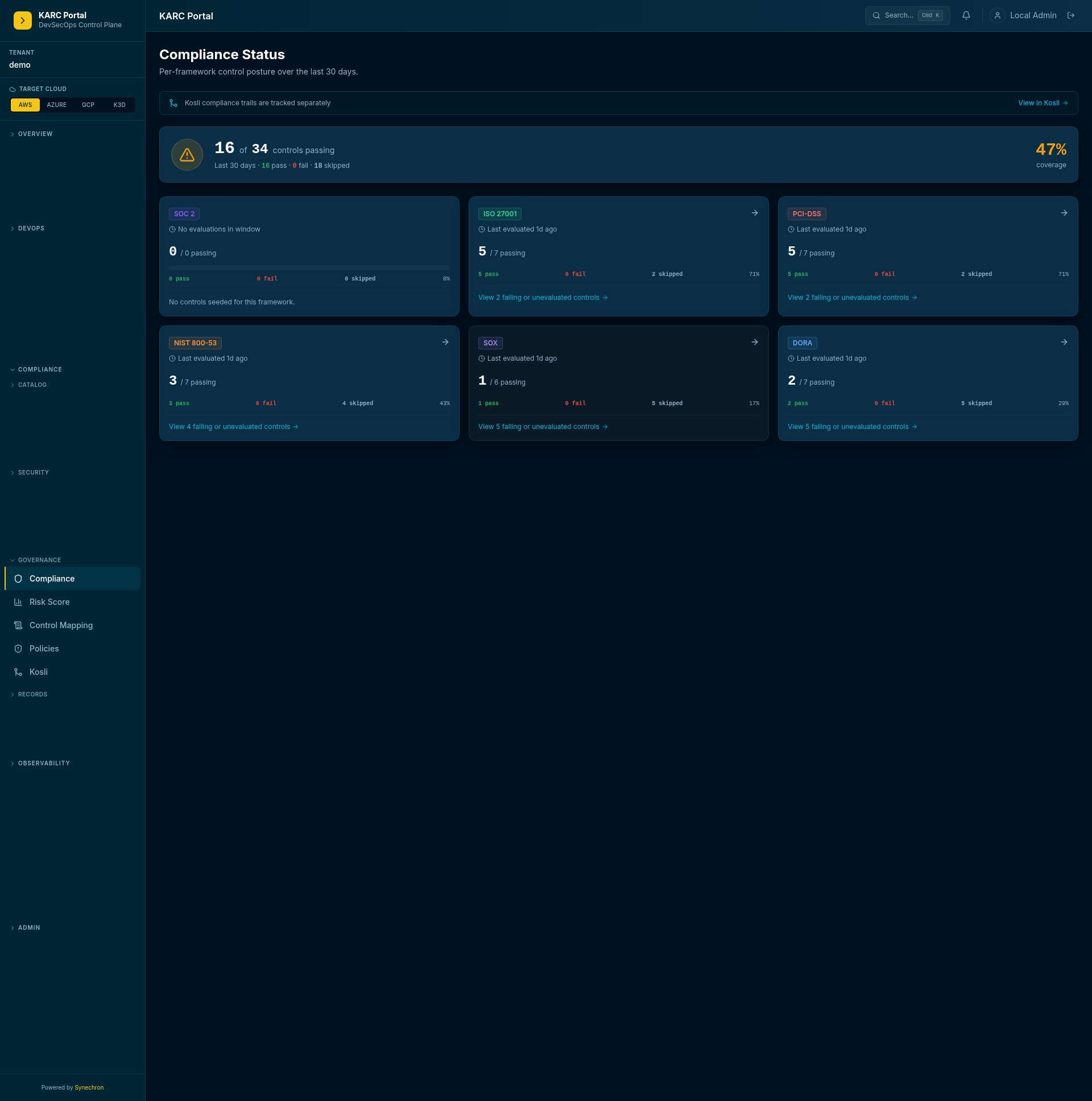
Real-time view against SOX, PCI DSS, DORA Regulation, ISO 27001, NIST 800-53 — controls present, controls satisfied, gaps remaining.
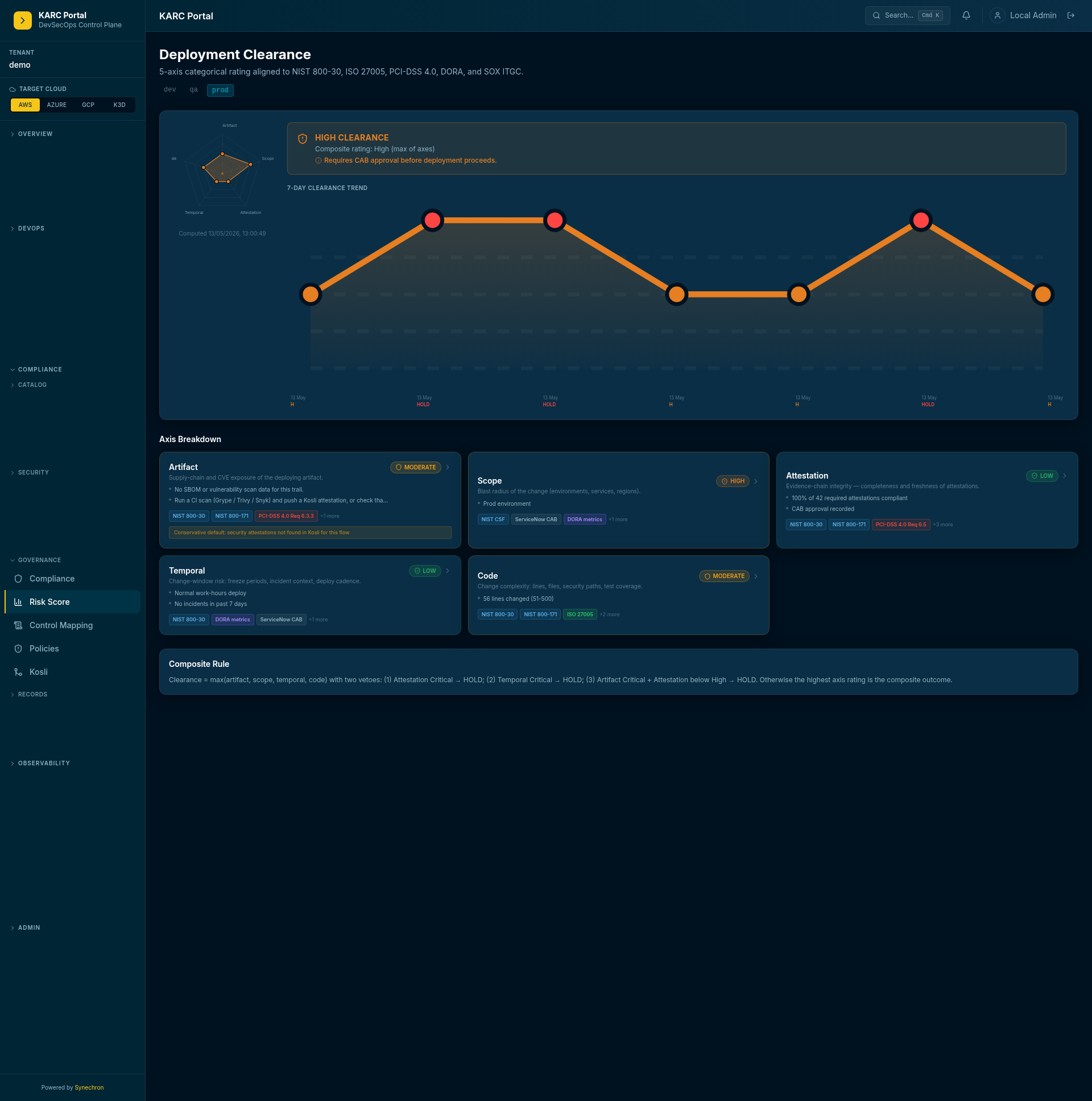
Per-deployment risk score 0–100 from the attestation graph; drives auto-approval thresholds (QA ≤ 5, prod ≤ 2).
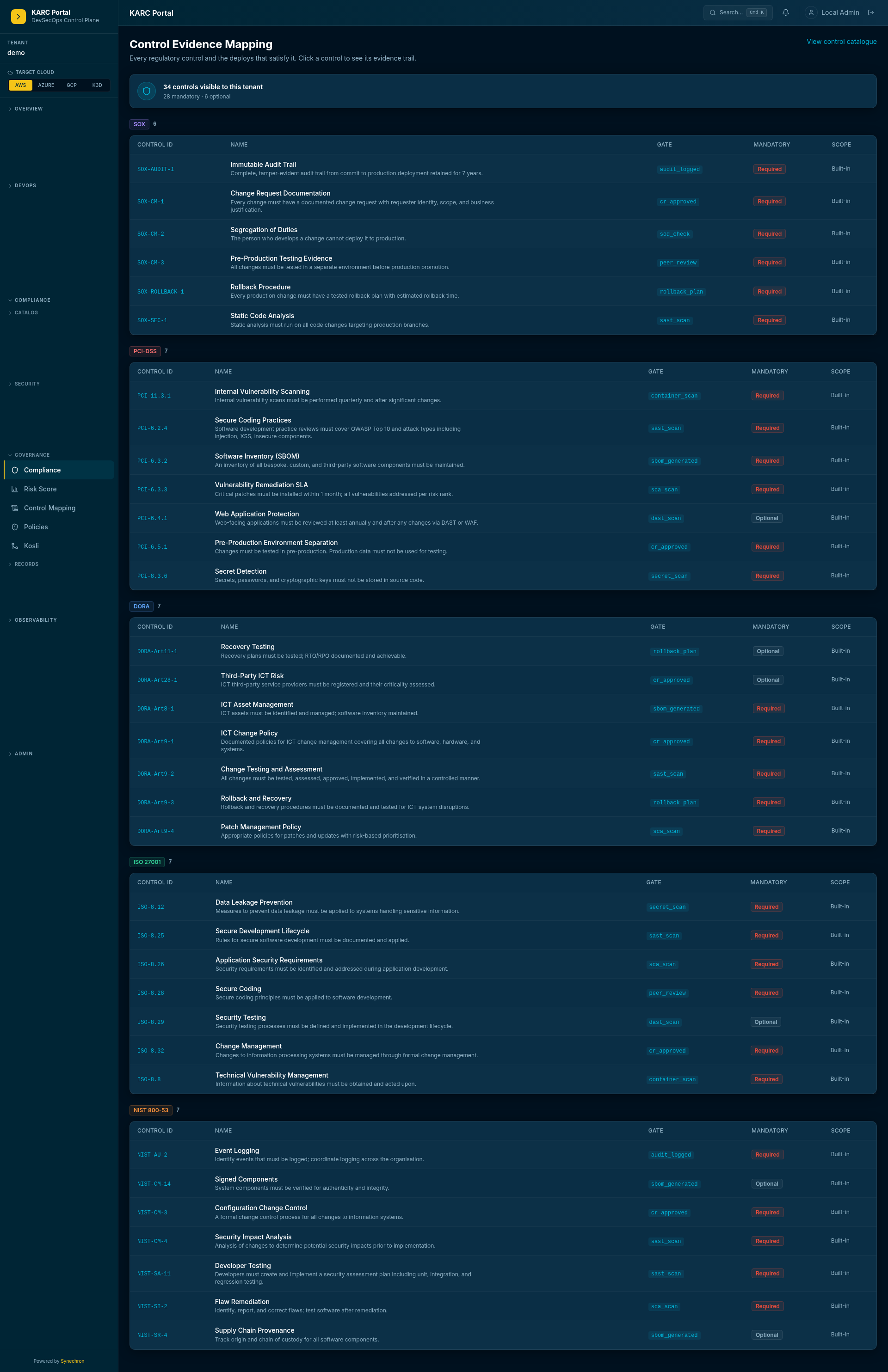
3-tile KPI strip, consolidated evidence table with single Links and Gap columns, 8-group cross-link sidebar, and 7/30/60/90-day window picker.
Fides + OPA policies with enforcement scope, last-evaluation result, and version history.
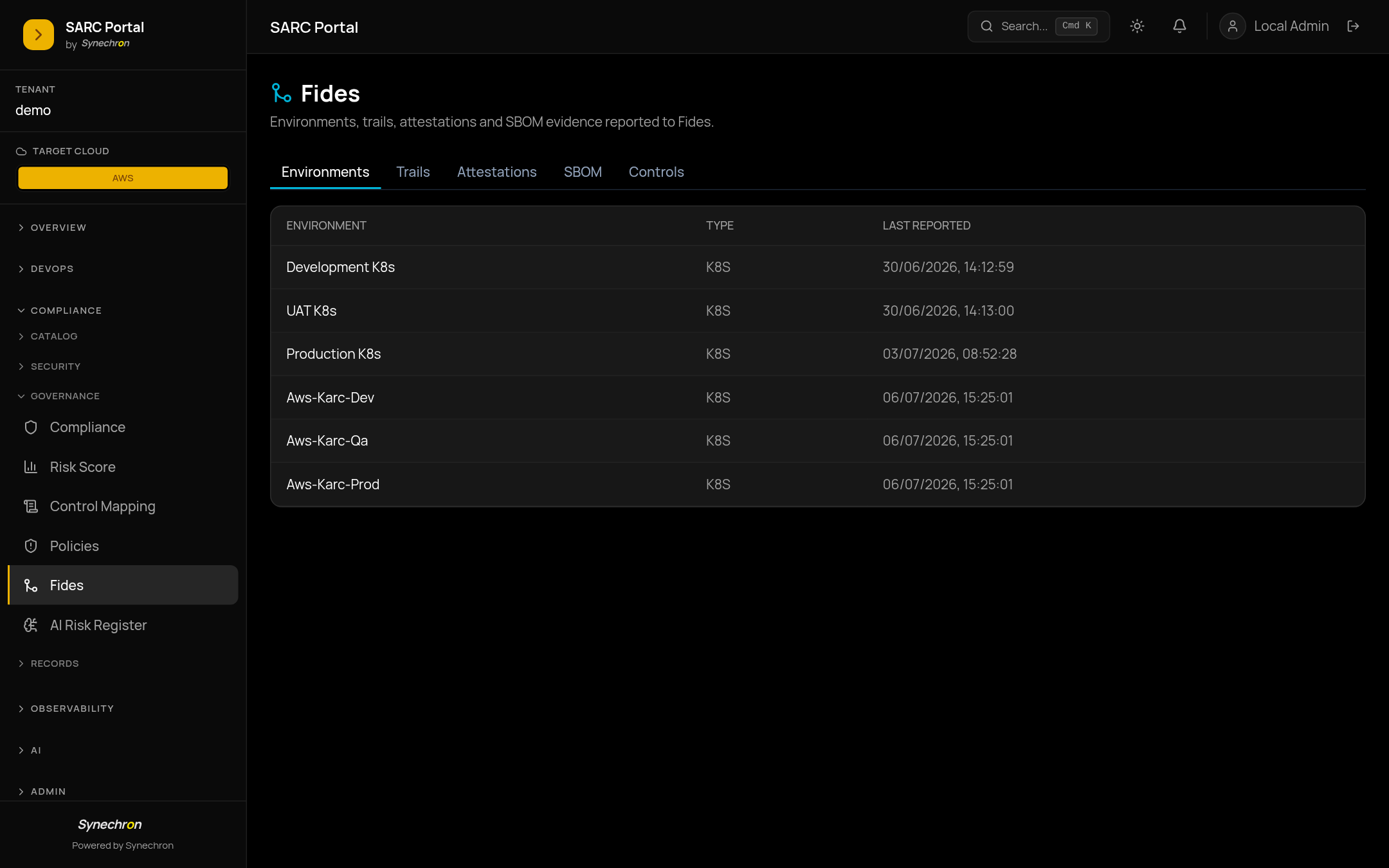
Live view of the karc-pipeline flow across 12 cloud × env environments — artifact attestations, deployment receipts, policy verdicts.
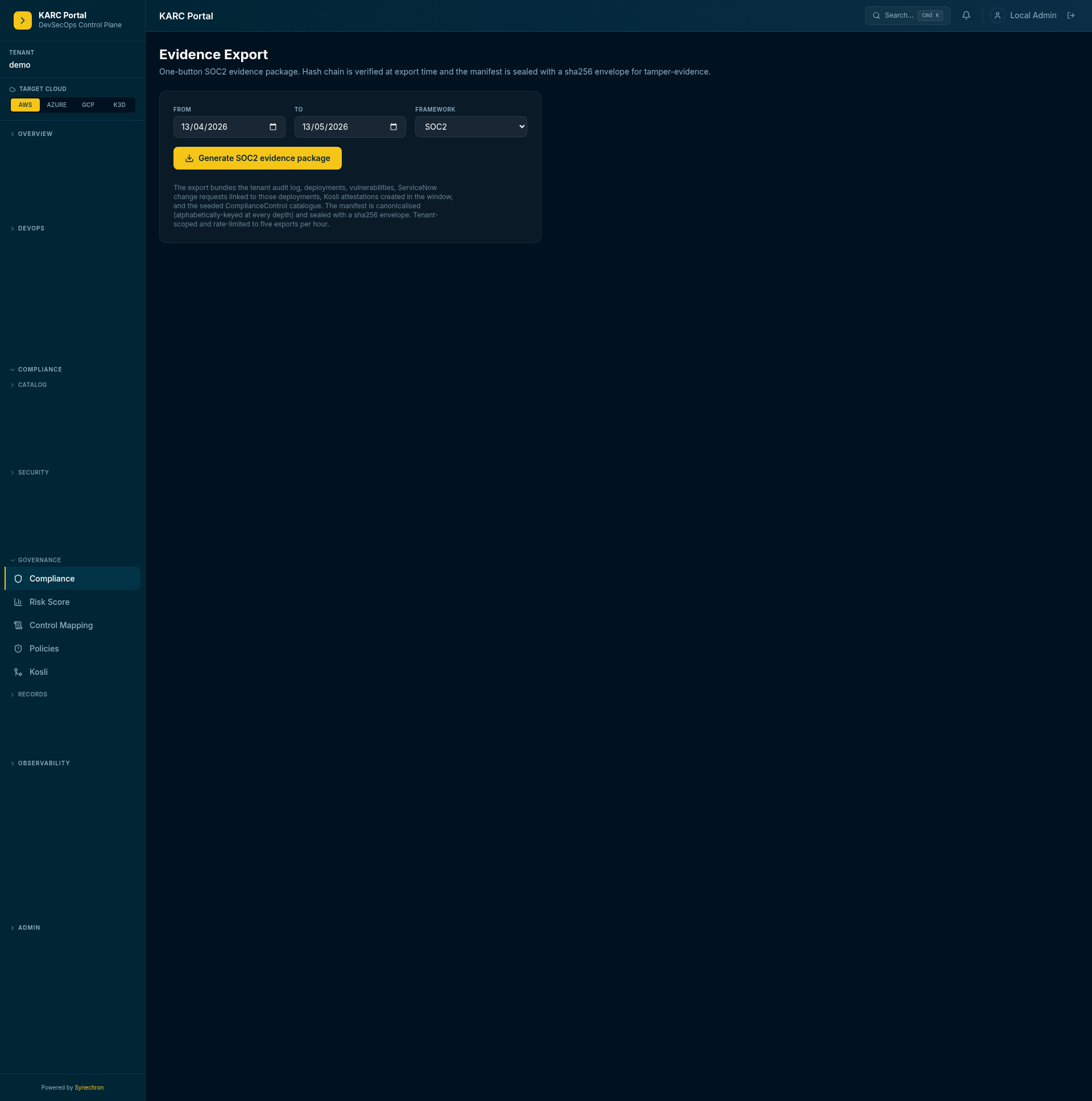
One-button SOC 2 evidence package with date-range + framework selector. Packages every attestation, SBOM, audit log entry, Fides trail, CR, and policy result into a canonical-JSON envelope, per-tenant rate-limited.
CMDB and releases

Every Configuration Item from ServiceNow (including OpenShift CIs) with operational state, version, environment, and deep-link to the full record. Every successful deploy updates the corresponding CI via the ServiceNow IRE API — the CMDB stays current without anyone touching it.
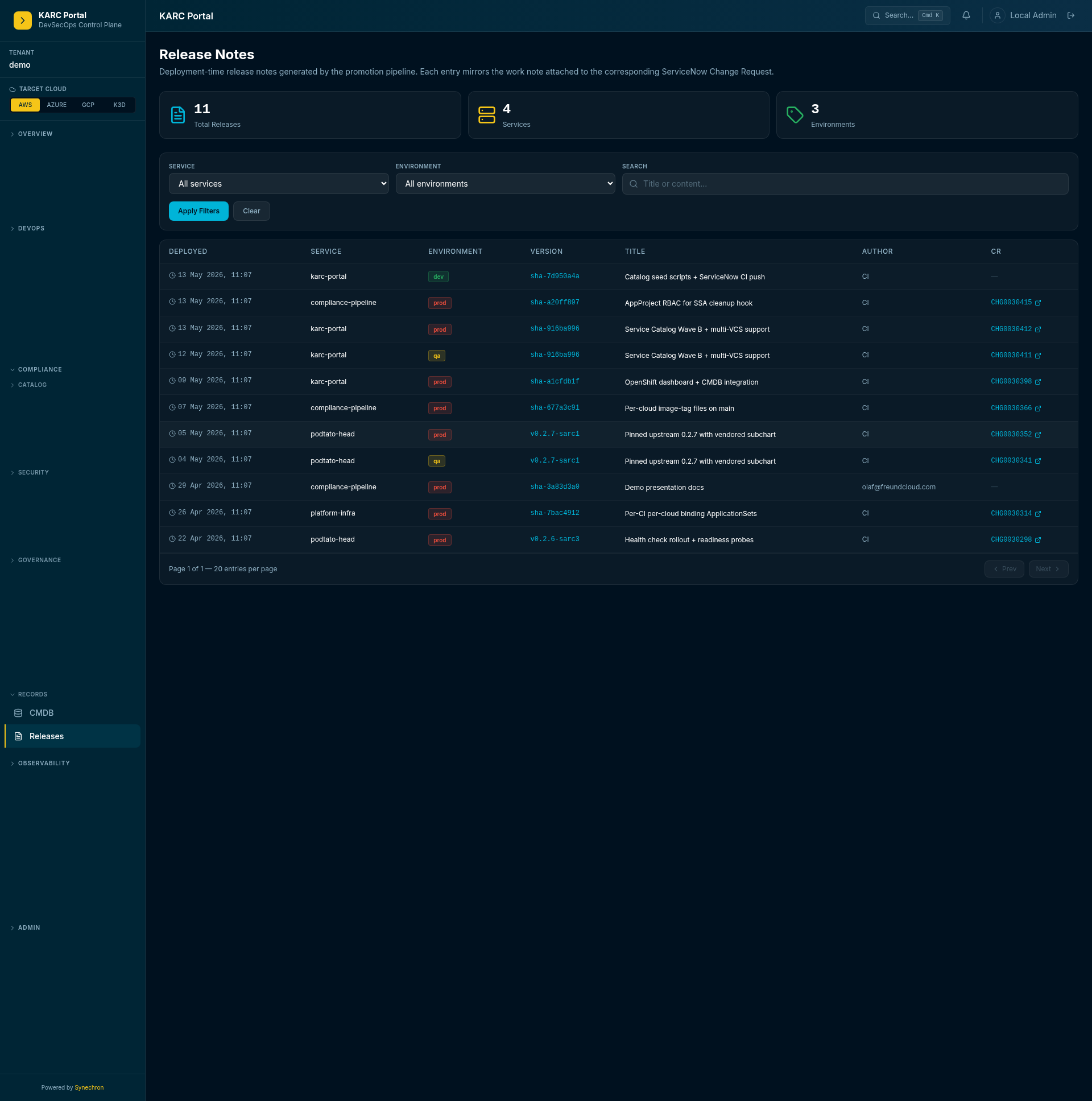
Release timeline with diff, attestation chain, deployment outcome, and rollback button.
Multi-cluster operations — Clusters, ArgoCD, Tekton, Costs
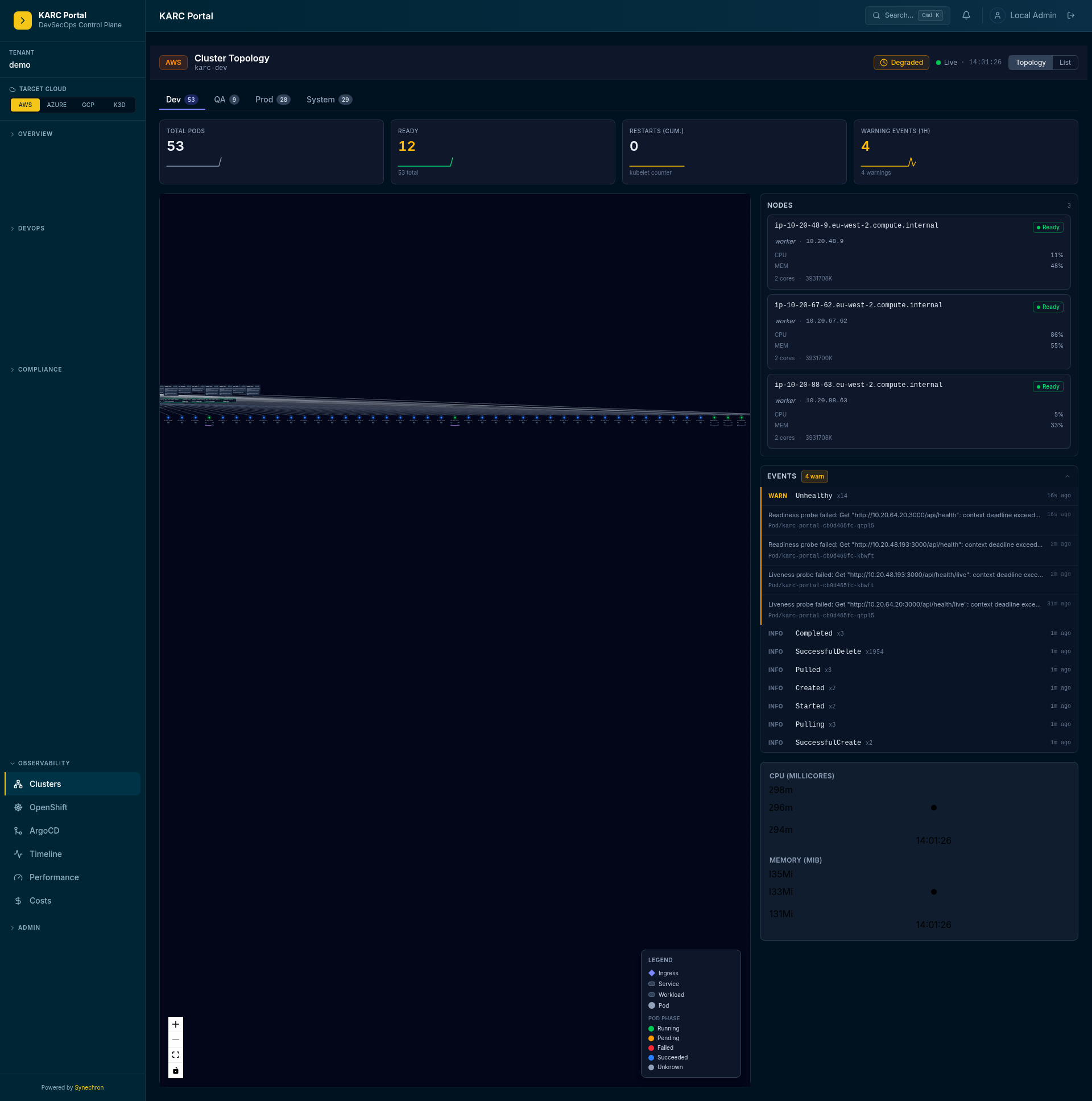
Live status across all configured clusters — node health, control-plane reachability, addon versions, kubeconfig context.
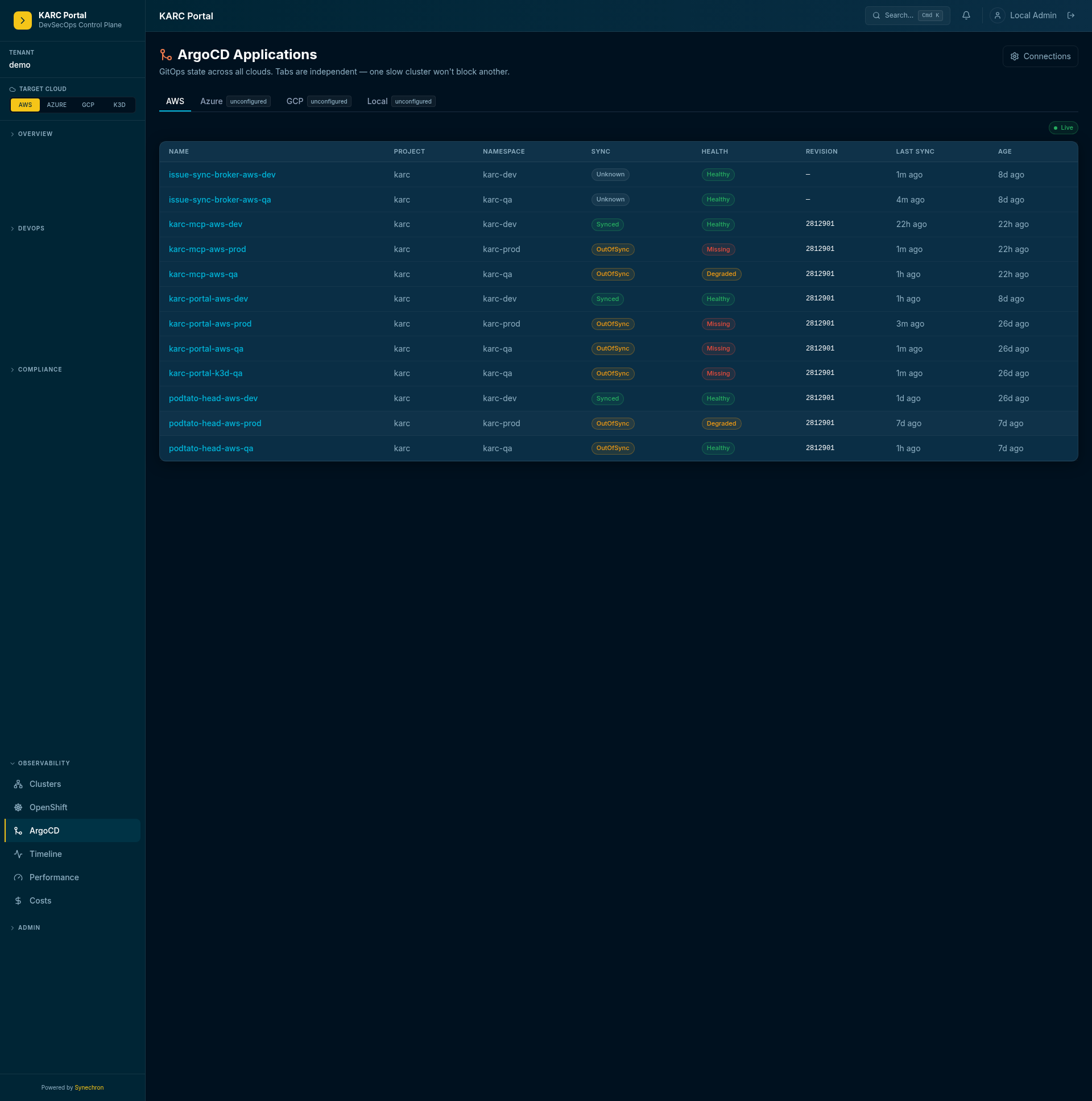
Multi-cluster GitOps with live SSE sync status, PreSync (Fides assert + ServiceNow CR) and PostSync (Fides report + DAST QA) hooks.

Chronological cross-cluster activity feed.
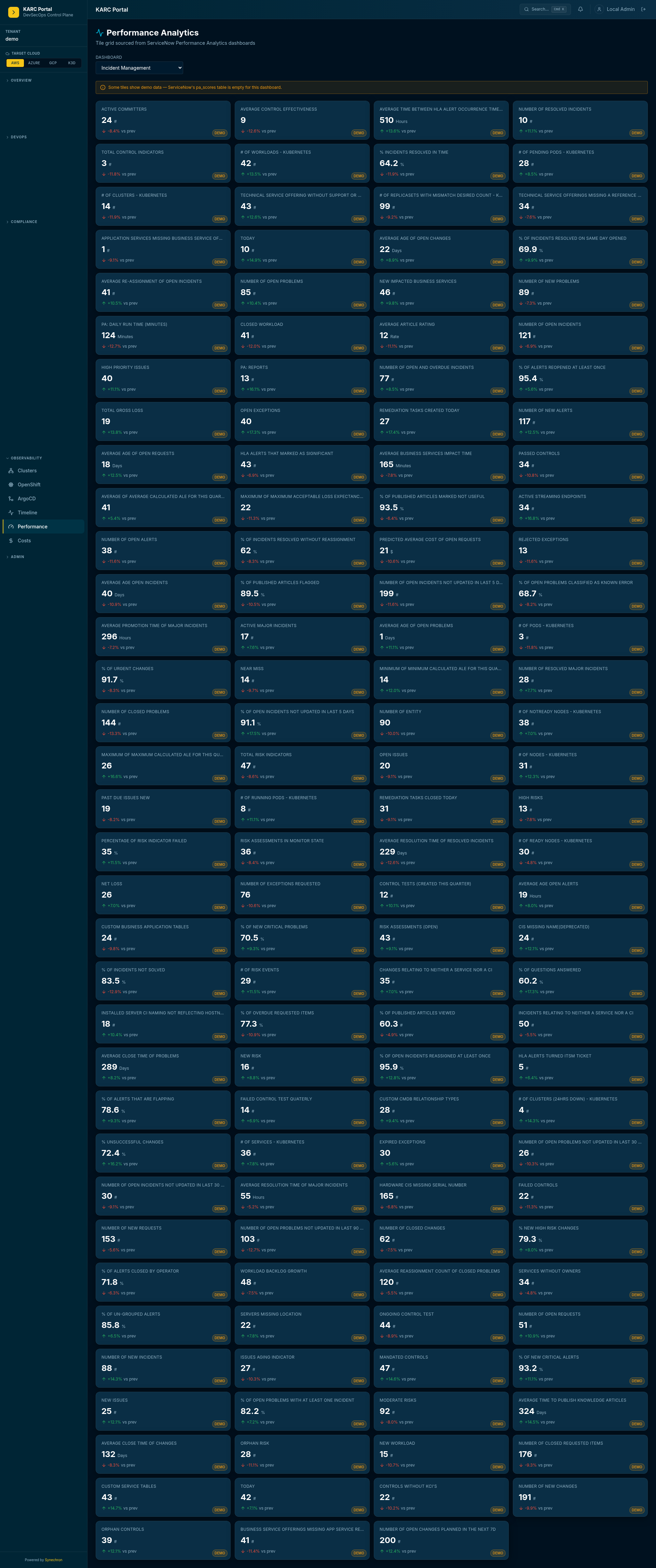
Per-service latency, error-rate, and resource-pressure tiles.
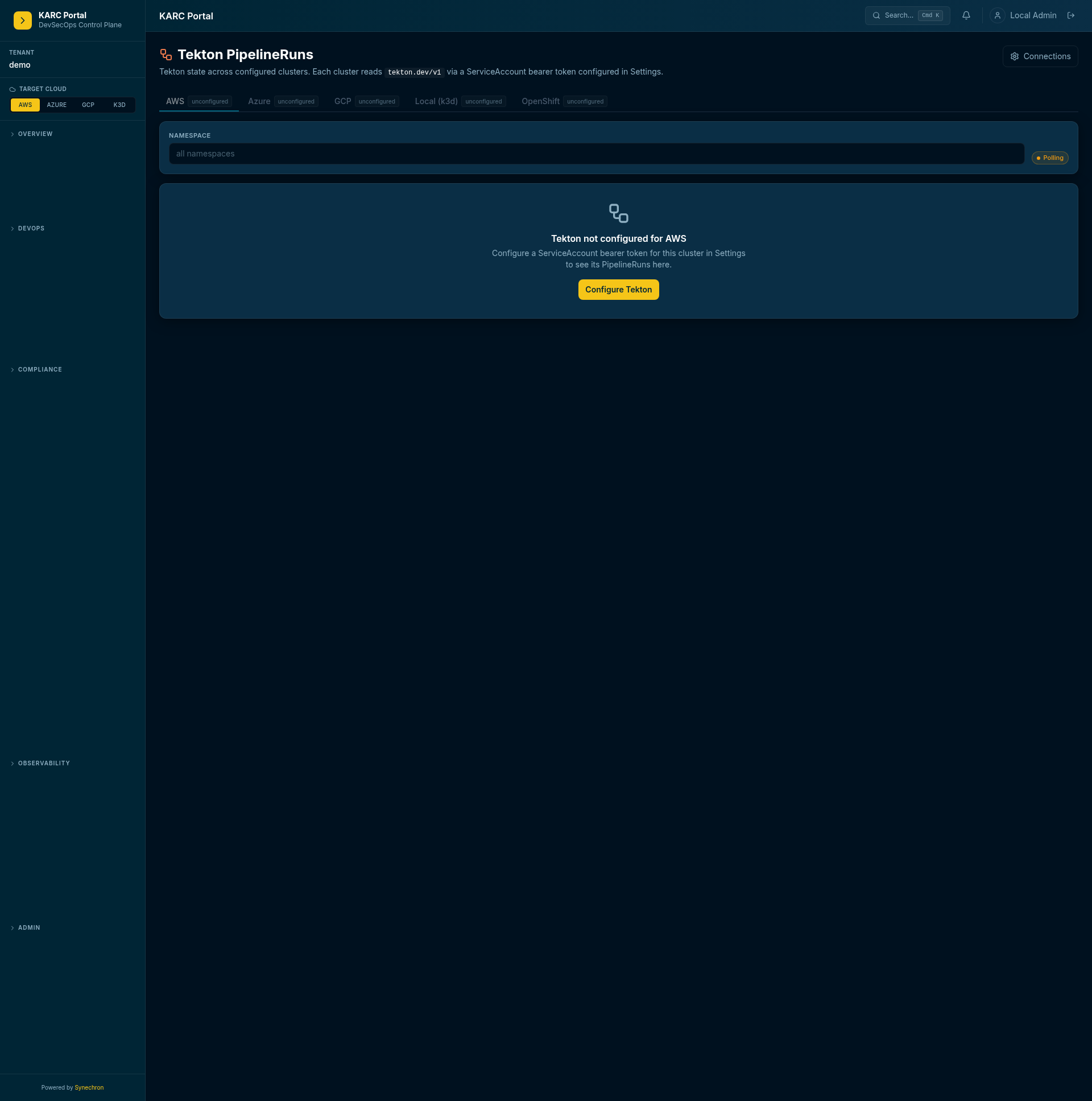
Multi-cluster PipelineRuns dashboard with live SSE status and step-log streaming across up to 5 cluster targets, configured per-tenant.
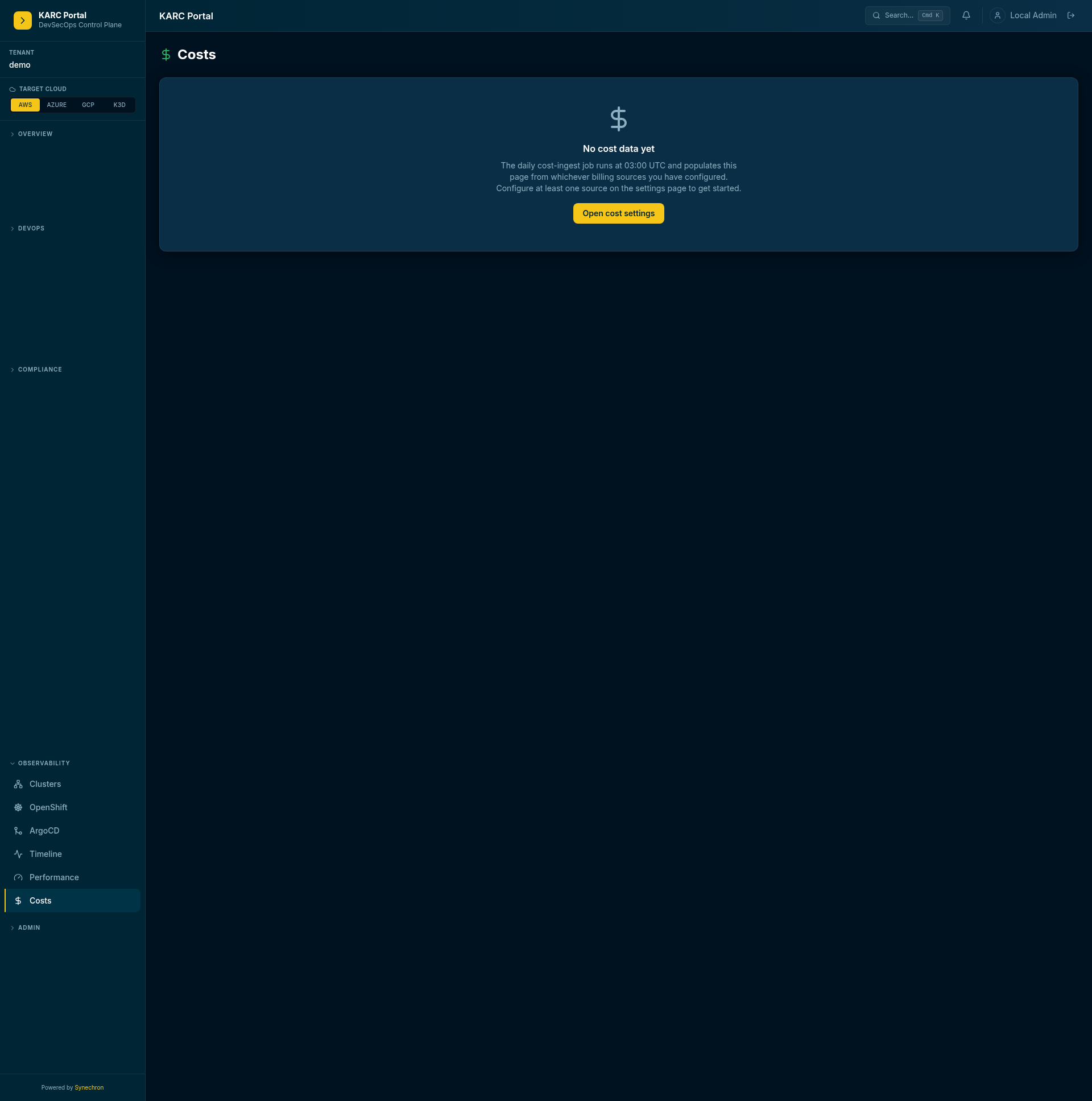
Per-service cost and chargeback from AWS Cost Explorer, Azure Cost Management, GCP Cloud Billing, and Kubecost — with cost ↔ vulnerability correlation.
Governance — Audit log, Users, Notifications

Every action — deployment, approval, rejection, rollback, settings change, risk acceptance — recorded with actor, timestamp, and a SHA-256 hash chained to the previous entry. JSON evidence package + printable HTML report exports.
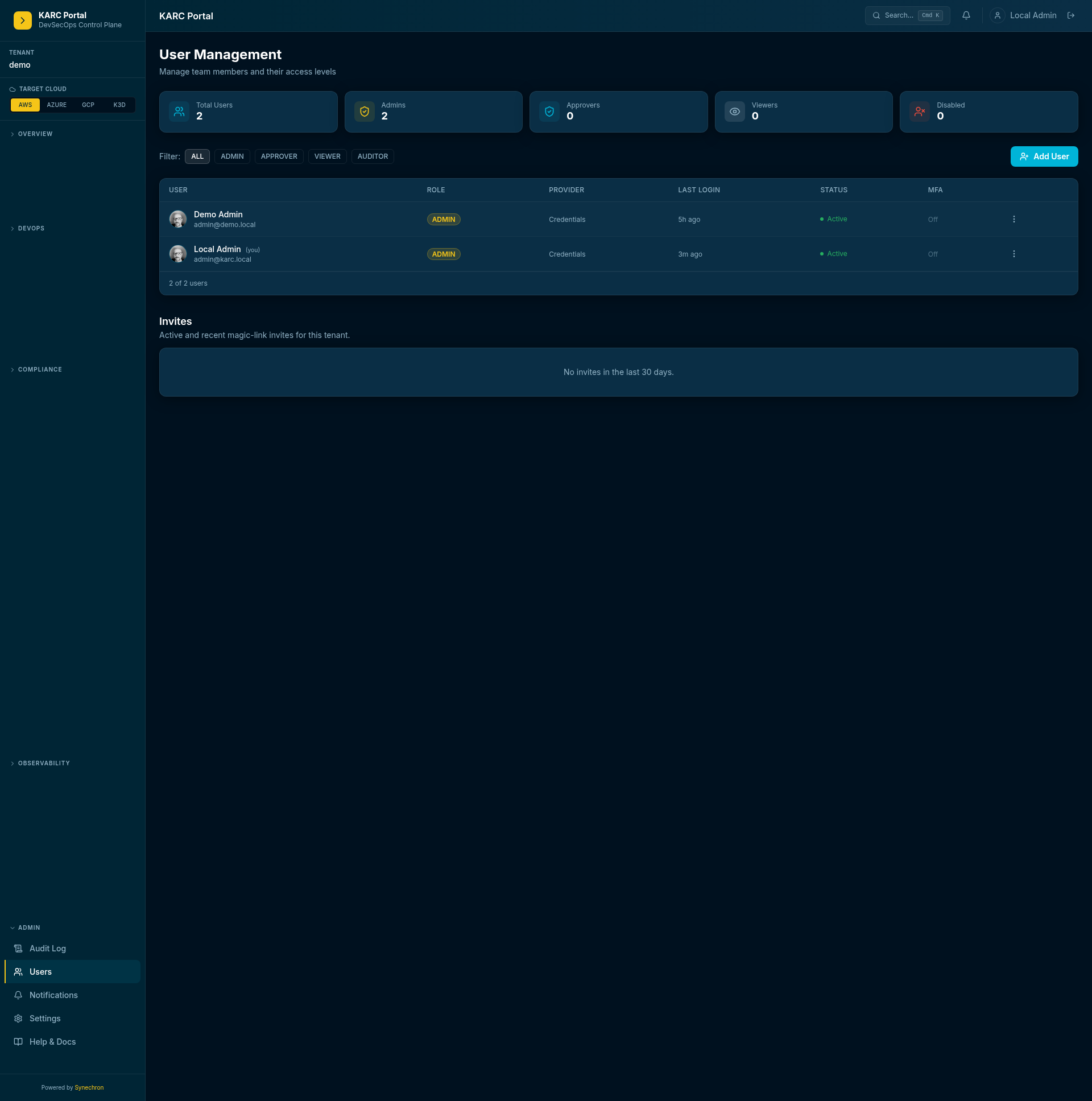
Three-role RBAC (Viewer / Approver / Admin) with magic-link invites, MFA, and disable-preserves-trail semantics.
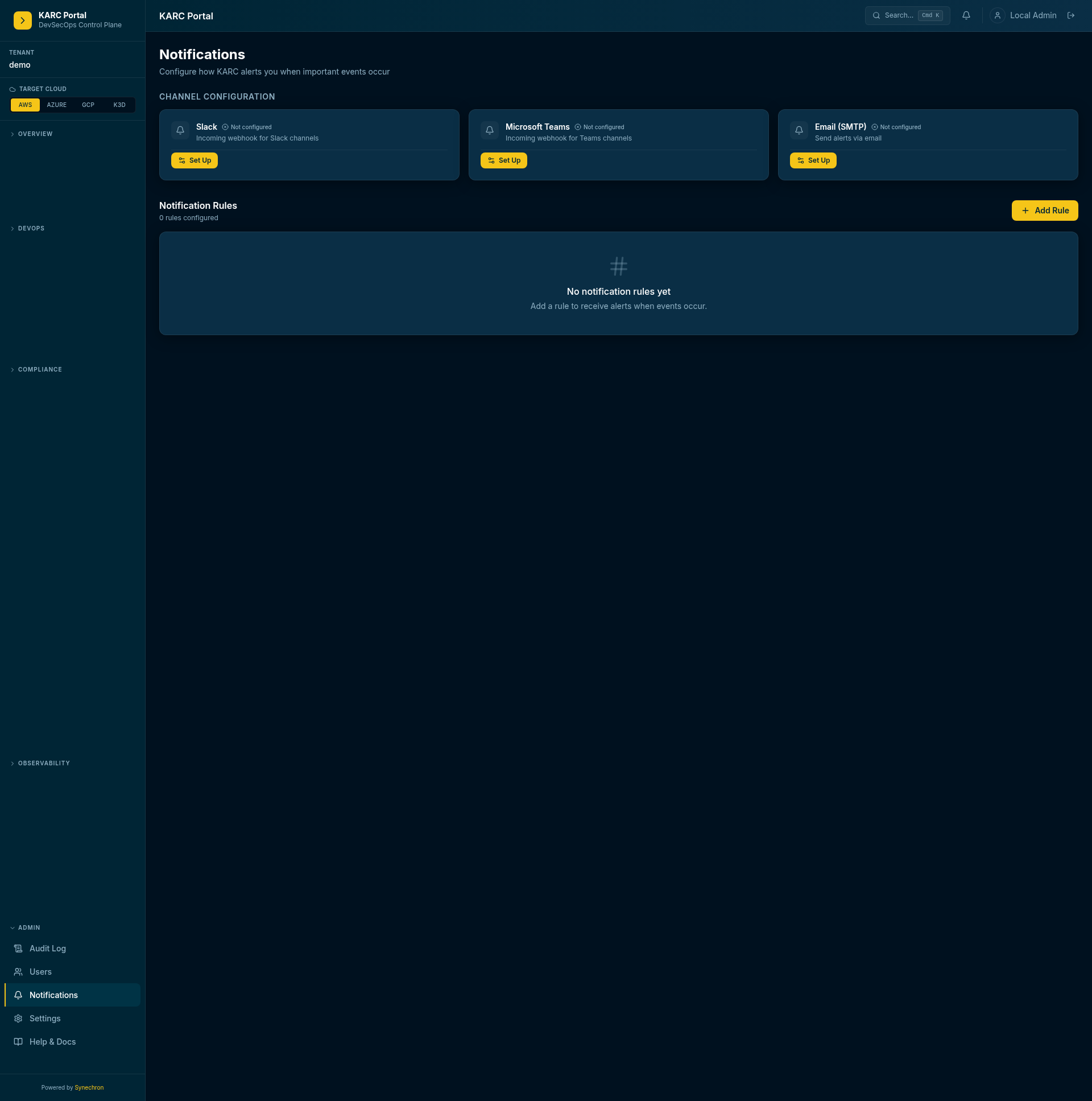
Slack, Teams, email, and webhook fan-out with per-rule severity threshold and channel routing.
Settings — wire your stack
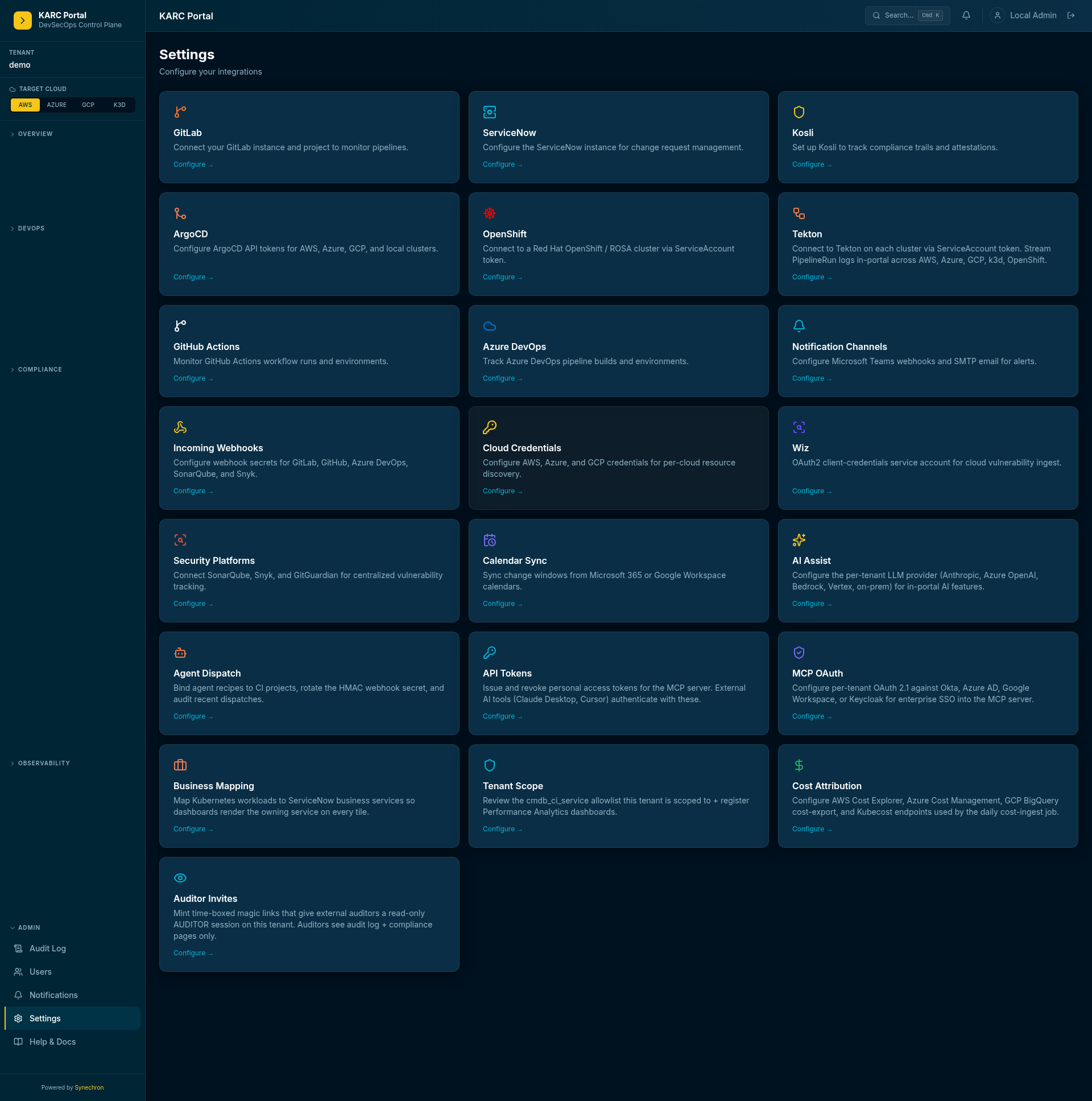
Every integration in one grid. Credentials encrypted at rest with AES-256-GCM; the portal never stores plain-text secrets.
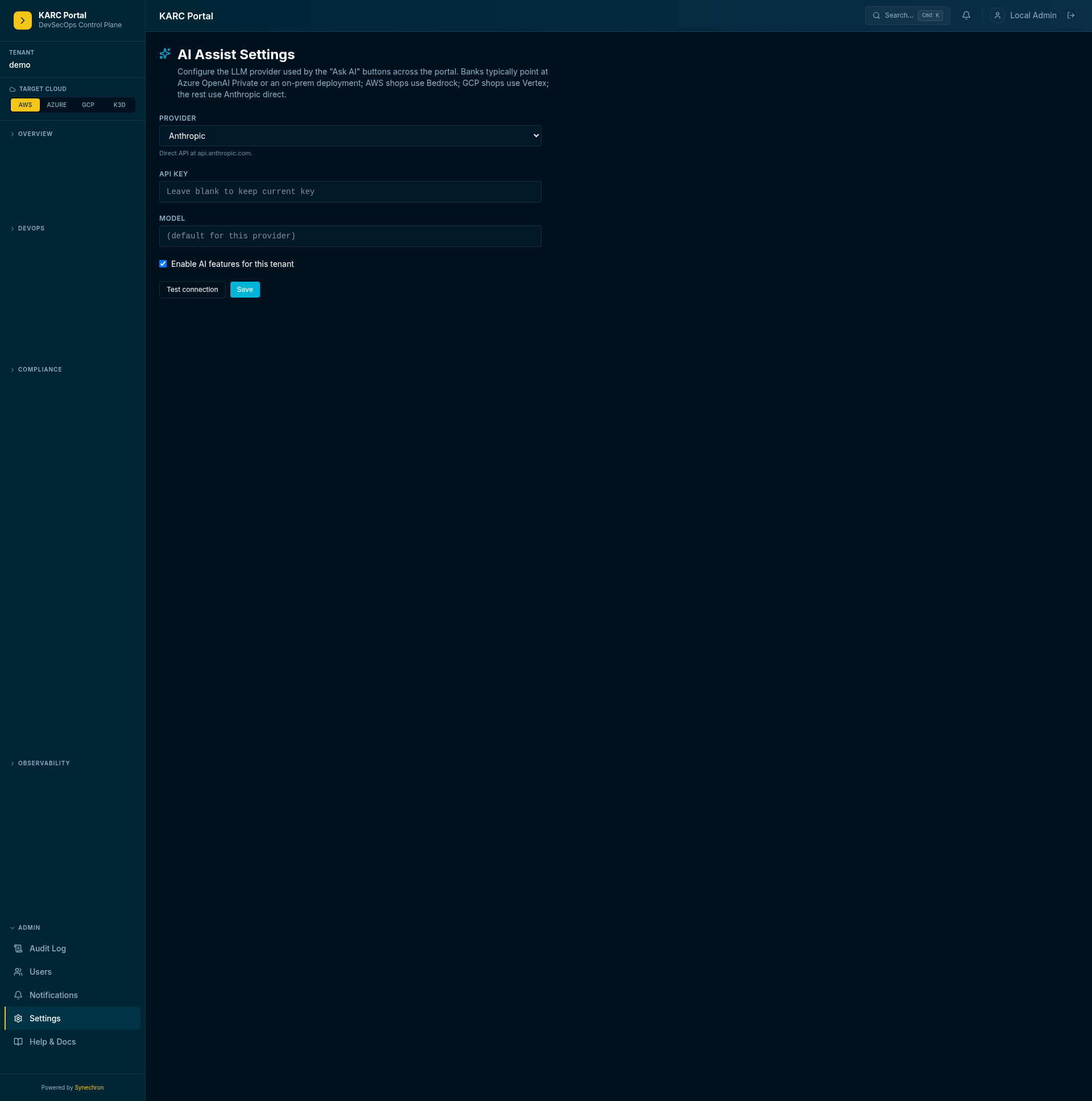
Multi-provider LLM configuration — Anthropic, Azure OpenAI, Bedrock, Vertex, on-prem — for AskAi popovers, natural-language search, and agent recipes. MCP server configuration lives here too.
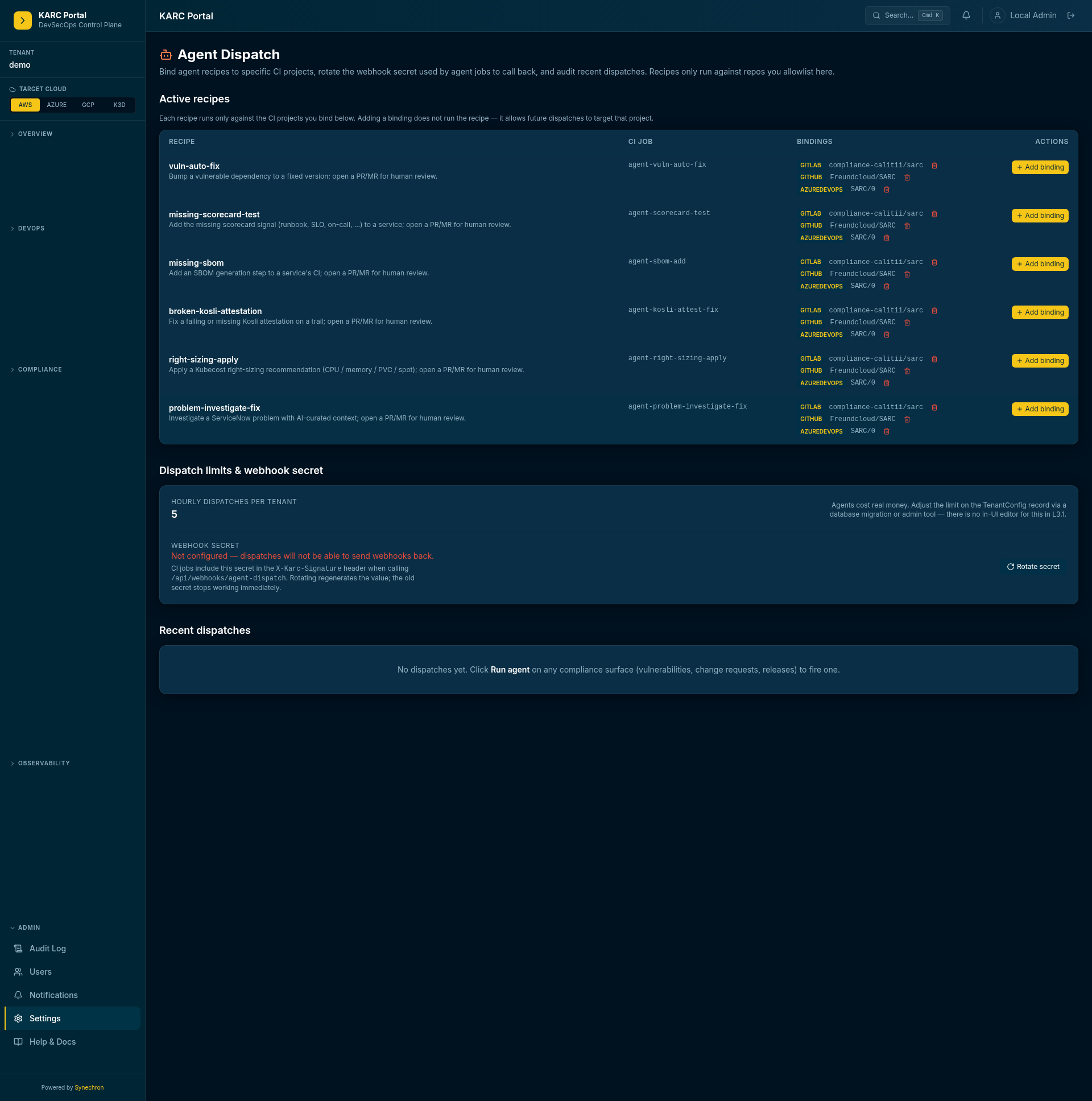
Agent recipe bindings: vuln-suggest-fix, problem-investigate-fix, right-sizing-apply dispatched to GitLab, GitHub, or Azure DevOps from in-row buttons on vulnerabilities, problems, and change requests.
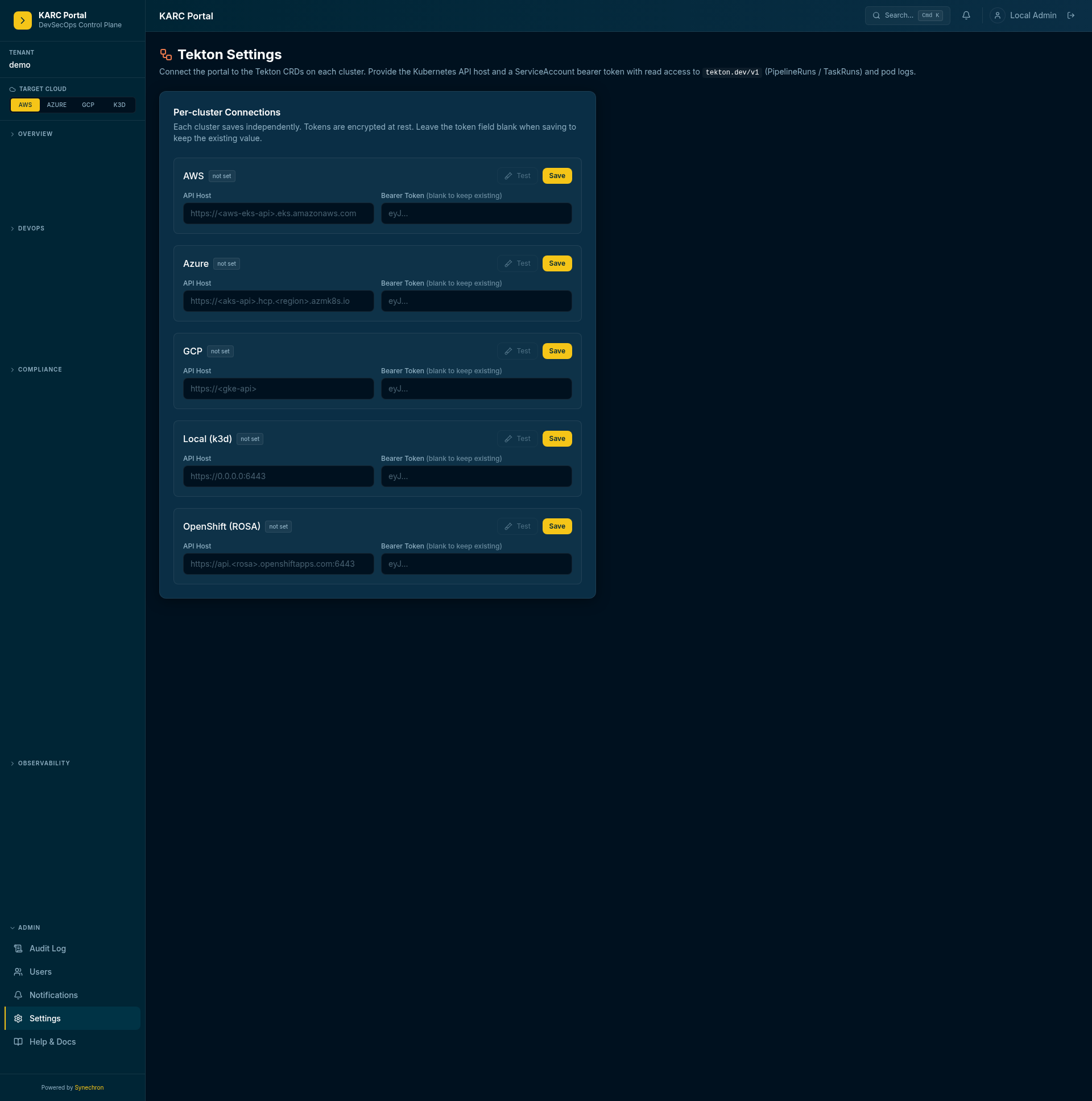
Per-tenant Tekton cluster targets — kubeconfig context, namespace scope, RBAC, live-SSE endpoints.
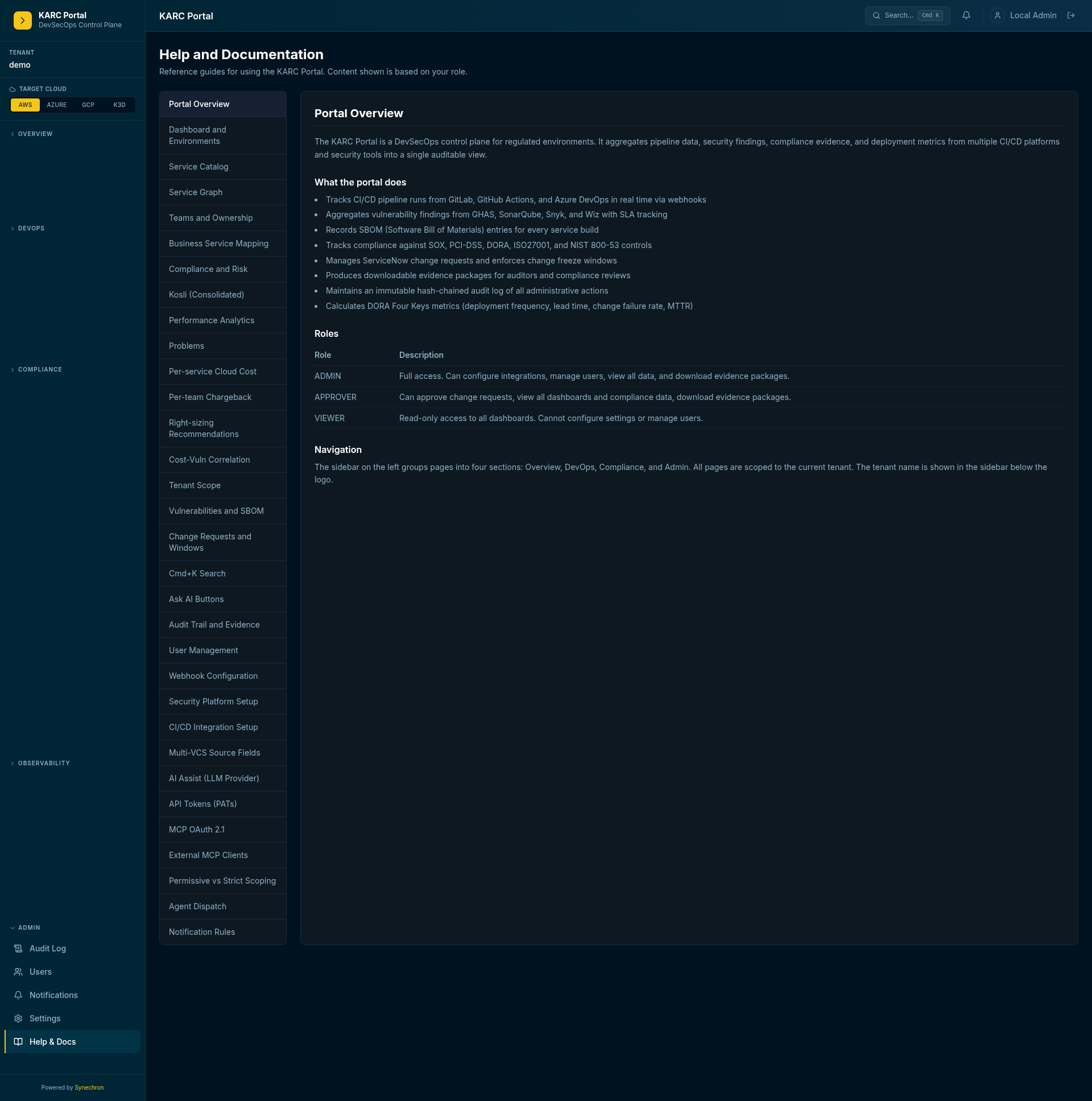
In-portal documentation filtered by role — compliance officers see plain-language framework explanations, admins see integration setup guides, engineers see dashboard usage.
AI Governance — SR 11-7 / OCC 2021-39 ready
A portal-wide dashboard at /ai/governance covering:
- Kill-switch for any registered model
- Model registry with version, provider, evaluation status
- Eval results with regression detection
- Risk register mapped to NIST AI 600-1 and ISO 42001 controls
- Guardrails — Llama Guard 3 input/output filtering and Microsoft Presidio PII redaction
- Cross-encoder reranker for retrieval quality
The same evidence-export mechanism that produces SOC 2 packs produces AI governance packs.
Compliance flow — one delivery cycle
End-to-end, an ARC delivery from issue to production:
- Issue filed — GitLab Issue / GitHub Issue / ADO Work Item; ID flows through commit messages to the ServiceNow CR.
- Branch from main — protected branch, signed commits, required CI status.
- Pre-commit hooks — yamllint, shellcheck, tfsec, checkov, gitleaks. The same checks the CI runs.
- Push triggers validate — terraform validate matrix × 3 clouds, helm lint + template matrix × 2 charts × 3 clouds.
- Build + scan — container image built, SAST + dependency + container + IaC + secret scans run, Fides artifact attestation emitted with digest + scan results.
- Deploy to dev — Helm install into
arc-devon the chosenTARGET_CLOUD. Portal lights up with the new artefact. - Open MR/PR — full evidence on the review surface: scans, SBOM, Fides chain. CODEOWNERS gates merge; Fides policy gate confirms attestations are present.
- Merge — kicks off the parallel mirror jobs (GitLab → GitHub + ADO) and the QA promotion path.
- Promote to QA —
scripts/ci/promote.shgenerates release notes, computes Fides risk score, creates ServiceNow CR with 13 custom fields, attaches SBOM + SARIF, auto-approves if risk ≤ 5, otherwise routes to a human. - Verify in QA — ArgoCD PostSync triggers a ZAP DAST scan; findings flow back to the portal.
- Promote to prod — always manual approval in ServiceNow, even for risk-zero. CR enriched with production evidence bundle (bulk attestation upload, control-mapping snapshot, SBOM hash chain).
- Verify in prod — Fides environment receipts, CMDB CI auto-updated via the IRE API, DORA lead-time clock recorded.
End-to-end: one issue, one branch, one merge, three environments, six attestations, two change requests (auto-approved QA, human-approved prod), a refreshed CMDB record, and a cryptographic chain of evidence an auditor can verify in seconds.
Multi-cloud implementation
The same Helm charts and the same pipeline produce four genuinely different cloud deployments. What’s identical and what diverges:
| Target | Cluster | Ingress | TLS | Secrets | Prod Postgres | Prod Redis | TF state |
|---|---|---|---|---|---|---|---|
| AWS | EKS 1.31 | ingress-nginx (NLB) | cert-manager + LE | Secrets Manager via IRSA | RDS PostgreSQL 16.4 | ElastiCache | S3 + DynamoDB |
| Azure | AKS 1.31 | ingress-nginx | cert-manager + LE | Key Vault via Workload Identity | Flexible Server 16.4 | Azure Cache | Azure Storage |
| GCP | GKE 1.31 regional | ingress-nginx | cert-manager + LE | Secret Manager via WI Federation | Cloud SQL POSTGRES_16 | Memorystore | GCS (versioned) |
| k3d (local) | k3d single-node | ingress-nginx | self-signed ClusterIssuer | plain Secret from .envrc |
bitnami subchart | bitnami subchart | local TF state |
Postgres major+minor is pinned across all four targets so a migration generated against the dev subchart applies cleanly against every managed service.
A deploy layers three Helm values files: values.yaml + values-${TARGET_CLOUD}.yaml + envs/${env}/values.yaml. Simple precedence — env overrides cloud overrides common.
CI mirror topology
GitLab is the source of truth. GitHub and Azure DevOps are read-only replicas refreshed after every successful pipeline on main:
        gitlab.com/compliance-calitii/sarc       (source of truth)
            |
            |  mirror stage (parallel jobs, --force-with-lease)
            v
   +--------+---------+
   |                  |
   v                  v
github.com/        dev.azure.com/
Freundcloud/SARC   olaffreund0455/SARC/_git/SARC
| Platform | Role | Key facts |
|---|---|---|
| GitLab | Source of truth | Canonical pipeline templates in .gitlab/ci/templates/; mirror jobs --force-with-lease, allow_failure: true so a mirror blip never blocks an upstream pipeline. |
| GitHub Actions | Full parity | 17 dispatchable orchestrator workflows + 20 reusable modules. OIDC auth to all three clouds — no long-lived credentials. |
| Azure Pipelines | In progress | Mirror live; pipeline parity follows. |
The same scripts/ci/*.sh shell modules are called by all three platforms — domain logic stays out of the platform-specific YAML.
Integrations catalogue
| System | Purpose |
|---|---|
| ServiceNow | Change Requests with 13 custom fields, Problems, CMDB sync (including OpenShift), pa_dashboards, multi-env approval gates |
| Fides | Artifact + deployment attestations, policy enforcement, flow karc-pipeline, 12 envs across 4 clouds |
| GitLab (source of truth) | Primary CI, Issues, MR flow |
| GitHub Actions | Full pipeline parity, OIDC to all clouds |
| Azure DevOps | Parity in progress |
| OpenShift (ROSA HCP) | Read-only CMDB + Builds + Routes + ImageStreams + ClusterOperators |
| Tekton | Multi-cluster PipelineRuns dashboard + live SSE + step-log streaming |
| ArgoCD | Multi-cluster GitOps with PreSync (Fides assert + ServiceNow CR) and PostSync (Fides report + DAST QA) hooks |
| Wiz / Snyk / SonarQube / GitGuardian / Trivy | CVE + scan intake for portal risk dashboards |
| AWS Cost Explorer / Azure Cost Mgmt / GCP Cloud Billing / Kubecost | Per-service cost + chargeback + cost-vuln correlation |
| Anthropic / Azure OpenAI / Bedrock / Vertex / on-prem | LLM provider for AskAi and natural-language search |
| AI Governance | Kill-switch, model registry, eval results, NIST AI 600-1 + ISO 42001 risk register, Llama Guard 3 + Presidio guardrails |
| Agent recipes | vuln-suggest-fix / problem-investigate-fix / right-sizing-apply dispatched to GitLab / GitHub / Azure DevOps |
| Microsoft 365 / Google Workspace | Change-window calendar sync |
| MCP server | HTTP transport, per-tenant Portal Tokens, 12 read tools + 3 prompts |
Tech stack
| Layer | Tooling |
|---|---|
| Portal | Next.js 15 (App Router), TypeScript, Prisma, NextAuth, Tailwind, shadcn/ui |
| Data | Postgres 16.4 (cloud-managed in prod, bitnami subchart in dev/k3d), Redis |
| Infrastructure | Terraform + OpenTofu, Helm, Kustomize, ArgoCD, Tekton, ingress-nginx, cert-manager, external-secrets |
| CI | GitLab CI templates, GitHub Actions reusable workflows, Azure Pipelines |
| Attestation + policy | Fides, OPA, cosign, Trivy, syft, grype |
| Compliance | ServiceNow CR + Problems + CMDB (IRE API), SOC 2 evidence export |
| AI | Multi-provider LLM, MCP server, Llama Guard 3, Microsoft Presidio, cross-encoder reranker |
| Dev environment | Nix flake (nix develop or direnv allow), just recipes, k3d, pre-commit hooks |
Try it locally
git clone https://gitlab.com/compliance-calitii/sarc.git
cd sarc
cp .envrc.example .envrc
# edit .envrc: fill in tokens for any integrations you want to demo
direnv allow                          # loads tools + tokens

just demo-up-k3d                      # cluster + ingress + cert-manager
                                      # + podtato-head + karc-portal
                                      # ~10 min on first run

just podtato-url dev                  # http://podtato.karc.localtest.me:8080
just portal-url   dev                 # http://portal.karc.localtest.me:8080

just k3d-down                         # tear down when done
Requires Nix (with flakes enabled), direnv, and Docker.
What this project is not
- Not a microservices demo. The microservices (podtato-head) are there as a realistic deployment target. The value is the compliance pipeline around them.
- Not production-ready as a business app. podtato-head is a CNCF cloud-native delivery reference app; the portal is an internal dashboard. Neither is intended to ship to end users.
- Not single-cloud. AWS was the predecessor (KARC) default. In ARC, no cloud is privileged — all four are first-class, and the pipeline produces the same evidence shape on every one.
Links
- Source (source of truth): gitlab.com/compliance-calitii/sarc
- GitHub mirror: github.com/Freundcloud/SARC
- License: Apache-2.0
Synechron ARC — the compliance pipeline platform that runs the same way on AWS, Azure, GCP, and a laptop.