Zero Trust Model
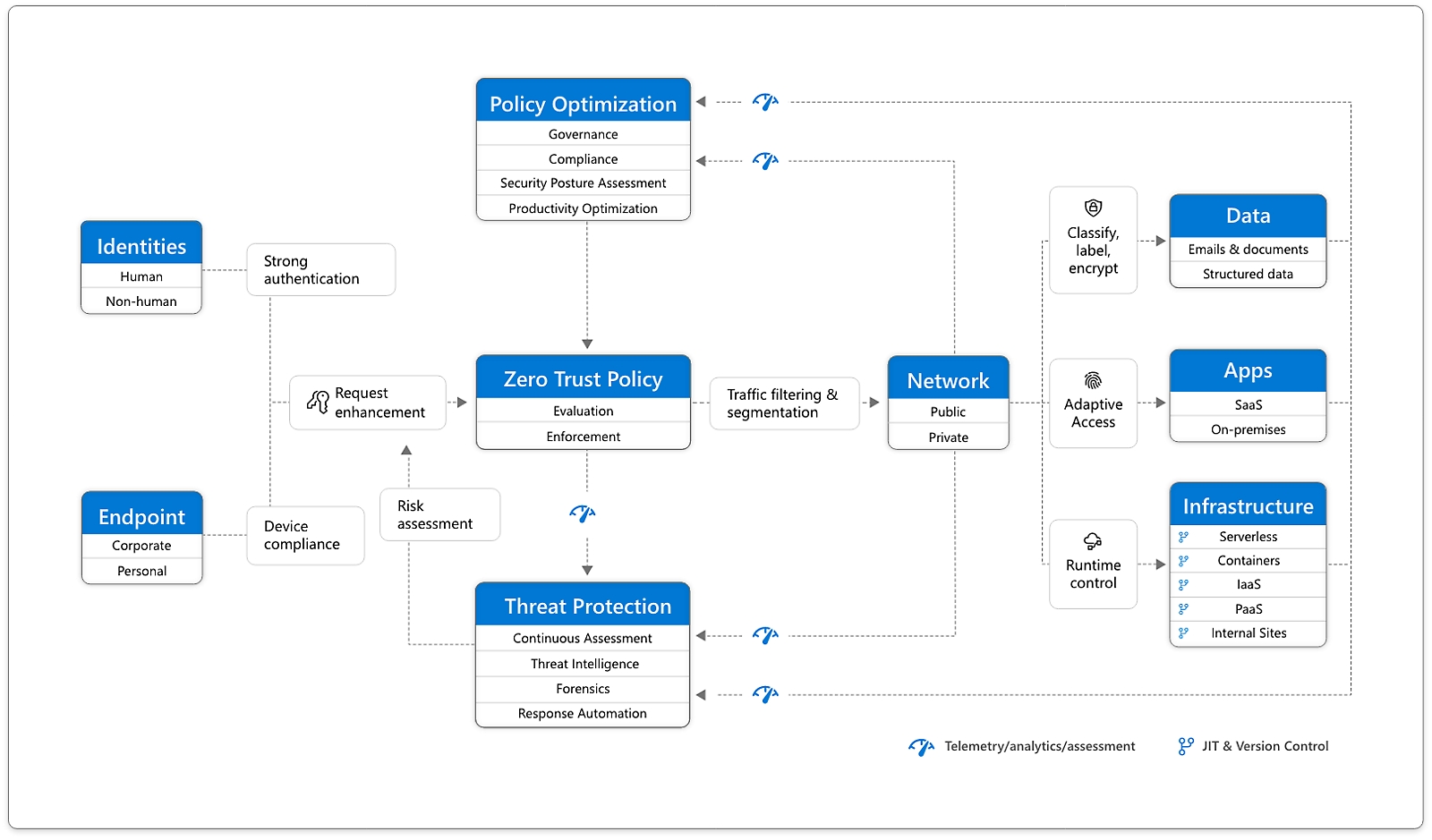
The Zero Trust model is a cybersecurity framework that assumes that all networks, devices, and users are untrusted until proven otherwise. In other words, it assumes that there is no perimeter, and all resources are accessed based on identity verification and authorization.
Core Principles
The Zero Trust model consists of several key principles:
- Identity and access management: Users and devices are authenticated and authorized before accessing any resources.
- Network segmentation: Resources are segmented and isolated based on their sensitivity and level of access.
- Micro-segmentation: Fine-grained access controls are applied to specific resources based on user identity and behavior.
- Least privilege: Users and devices are granted the minimum level of access required to perform their tasks.
- Data encryption: Data is protected with strong encryption, both in transit and at rest.
- Continuous monitoring: Security events are continuously monitored for signs of suspicious activity.
- Automation: Security policies and controls are automated to reduce the risk of human error.
The Zero Trust model assumes that traditional perimeter-based security models are no longer effective in protecting against modern threats like phishing, malware, and ransomware. Instead, it focuses on protecting individual resources and data, regardless of their location or form.
Implementation in Cloud Environments
AWS Implementation
AWS provides several services to implement a Zero Trust architecture:
- Identity and Access Management:
- AWS IAM for fine-grained permissions
- AWS Single Sign-On for centralized access management
- AWS Identity Center for workforce authentication
- Network Controls:
- VPC with security groups and NACLs
- AWS PrivateLink for private connectivity
- AWS Transit Gateway for network segmentation
- Continuous Verification:
- AWS GuardDuty for threat detection
- AWS CloudTrail for activity monitoring
- AWS Security Hub for compliance monitoring
Example AWS IAM Policy with Least Privilege:
{
  "Version": "2012-10-17",
  "Statement": [
    {
      "Effect": "Allow",
      "Action": [
        "s3:GetObject",
        "s3:ListBucket"
      ],
      "Resource": [
        "arn:aws:s3:::my-bucket",
        "arn:aws:s3:::my-bucket/*"
      ],
      "Condition": {
        "IpAddress": {
          "aws:SourceIp": ["192.0.2.0/24"]
        },
        "StringEquals": {
          "aws:PrincipalTag/Department": "Finance"
        },
        "DateGreaterThan": {
          "aws:CurrentTime": "2023-04-01T00:00:00Z"
        },
        "DateLessThan": {
          "aws:CurrentTime": "2023-12-31T23:59:59Z"
        }
      }
    }
  ]
}
Azure Implementation
Azure provides a comprehensive set of tools for Zero Trust implementation:
- Identity Management:
- Azure Active Directory (Azure AD) for identity verification
- Conditional Access for context-based authentication
- Azure AD Privileged Identity Management for just-in-time access
- Network Security:
- Azure Virtual Network for segmentation
- Azure Private Link for secure private connectivity
- Azure Firewall for traffic filtering
- Device Security:
- Microsoft Intune for device management
- Microsoft Endpoint Manager for endpoint security
- Azure AD Join for device identity
Example Azure Conditional Access Policy:
name: Finance Apps - Require MFA
state: enabled
conditions:
  users:
    include:
      - groupIds: ["finance-group-id"]
    exclude:
      - roleIds: ["emergency-access-accounts"]
  applications:
    include:
      - appIds: ["finance-app-1-id", "finance-app-2-id"]
  clientAppTypes:
    - browser
    - mobileAppsAndDesktopClients
  locations:
    include:
      - all
    exclude:
      - locationIds: ["corporate-network-location-id"]
  deviceStates:
    include:
      - all
grantControls:
  operator: AND
  builtInControls:
    - mfa
    - compliantDevice
sessionControls:
  applicationEnforcedRestrictions: true
  disableResilienceDefaults: false
  signInFrequency:
    value: 4
    type: hours
  persistentBrowser:
    mode: never
GCP Implementation
Google Cloud Platform offers these Zero Trust components:
- Identity and Access:
- Google Cloud IAM for resource access control
- Identity-Aware Proxy (IAP) for context-aware access
- Google Workspace for user authentication
- Network Security:
- VPC Service Controls for API perimeter security
- Cloud Armor for application protection
- Cloud NAT for outbound-only connectivity
- Data Protection:
- Google Cloud KMS for encryption key management
- Secret Manager for secrets handling
- VPC flow logs for network monitoring
Example GCP VPC Service Controls Configuration:
name: "projects/my-project/servicePerimeters/finance_perimeter"
title: "Finance Data Perimeter"
description: "Perimeter for finance data resources"
status:
  resources:
  - "projects/123456789012"
  restrictedServices:
  - "bigquery.googleapis.com"
  - "storage.googleapis.com"
  vpcAccessibleServices:
    allowedServices:
    - "bigquery.googleapis.com"
  ingressPolicies:
  - ingressFrom:
      sources:
      - accessLevel: "accessPolicies/123456789/accessLevels/trusted_devices"
    ingressTo:
      operations:
      - serviceName: "bigquery.googleapis.com"
        methodSelectors:
        - method: "google.cloud.bigquery.v2.TableDataService.List"
      resources:
      - "*"
Practical Implementation Steps
1. Identity-Centric Approach
Start with establishing a strong identity foundation:
- Implement Multi-Factor Authentication (MFA):
# AWS CLI example for enforcing MFA aws iam create-policy --policy-name RequireMFA --policy-document file://require-mfa-policy.json # Azure CLI example for MFA configuration check az ad conditional-access policy list --query "[?displayName=='Require MFA for all users']" - Enable Just-In-Time (JIT) access:
# PowerShell example for Azure PIM role activation
Connect-AzureAD
$role = Get-AzureADMSPrivilegedRoleDefinition -ProviderId "aadRoles" -ResourceId "tenant-id" -Id "role-id"
$schedule = New-Object Microsoft.Open.MSGraph.Model.AzureADMSPrivilegedSchedule
$schedule.Type = "Once"
$schedule.StartDateTime = (Get-Date).ToUniversalTime().ToString("yyyy-MM-ddTHH:mm:ss.fffZ")
$schedule.EndDateTime = (Get-Date).AddHours(8).ToUniversalTime().ToString("yyyy-MM-ddTHH:mm:ss.fffZ")
Open-AzureADMSPrivilegedRoleAssignmentRequest -ProviderId "aadRoles" -ResourceId "tenant-id" -RoleDefinitionId $role.Id -SubjectId "user-id" -Type "UserAdd" -AssignmentState "Active" -schedule $schedule -Reason "Emergency Access"
2. Network Micro-Segmentation
Create security boundaries around resources:
- AWS Security Groups for fine-grained control:
# Create security group allowing only necessary access aws ec2 create-security-group --group-name app-tier-sg --description "App Tier" --vpc-id vpc-1234567 aws ec2 authorize-security-group-ingress --group-id sg-abc123 --protocol tcp --port 443 --source-group sg-def456 - Azure NSGs with advanced rules:
# Create NSG with specific application rules
az network nsg create --name app-nsg --resource-group myRG
az network nsg rule create --name allow-app-traffic --nsg-name app-nsg --priority 100 \
  --resource-group myRG --access Allow --source-address-prefixes 10.0.1.0/24 \
  --destination-port-ranges 8443 --protocol Tcp
3. Continuous Monitoring and Verification
Implement real-time monitoring and anomaly detection:
- Set up automated responses to security events:
# AWS EventBridge rule example Resources: SecurityEventRule: Type: AWS::Events::Rule Properties: Name: detect-unusual-access Description: "Detect unusual access patterns" EventPattern: source: - "aws.guardduty" detail-type: - "GuardDuty Finding" detail: severity: - 7 - 8 - 9 State: ENABLED Targets: - Arn: !GetAtt RemediationFunction.Arn Id: RemediateSecurityEvent - GCP Security Command Center integration:
# Enable Security Command Center
gcloud scc settings update --organization=ORGANIZATION_ID --enable-security-center

# Configure automated notifications
gcloud scc notifications create scc-notify \
  --description "Critical security findings" \
  --pubsub-topic projects/my-project/topics/scc-notifications \
  --filter "severity='HIGH' OR severity='CRITICAL'" \
  --organization=ORGANIZATION_ID
Benefits of Zero Trust
Adopting the Zero Trust model can bring a number of benefits to organizations, including:
- Improved security posture: By assuming that all resources are untrusted, the Zero Trust model provides a more comprehensive and proactive approach to security.
- Better compliance: The Zero Trust model helps organizations meet regulatory requirements by providing greater visibility and control over access to sensitive data.
- Greater flexibility and agility: The Zero Trust model enables organizations to be more flexible and agile in their use of cloud services, mobile devices, and other emerging technologies.
- Reduced risk of data breaches: By implementing strong access controls and encryption, the Zero Trust model reduces the risk of data breaches and other security incidents.
- Enhanced visibility: Continuous monitoring provides better visibility into network traffic and user behavior.
Real-World Zero Trust Implementation Case Study
Financial Services Migration to Multi-Cloud
A global financial institution implemented Zero Trust while migrating services to a multi-cloud environment:
Challenge: Secure access to sensitive financial applications across AWS and Azure while maintaining compliance with financial regulations.
Solution:
- Centralized Identity Management:
- Implemented Azure AD as the primary identity provider
- Federated with AWS IAM and on-premises Active Directory
- Configured SAML-based SSO for all applications
- Context-Based Access Controls:
# Terraform example for AWS IAM Identity Center permissions resource "aws_ssoadmin_permission_set" "finance_analysts" { name = "FinanceAnalysts" description = "Permission set for financial analysts" instance_arn = aws_ssoadmin_instance.main.arn session_duration = "PT8H" } resource "aws_ssoadmin_managed_policy_attachment" "finance_readonly" { instance_arn = aws_ssoadmin_instance.main.arn managed_policy_arn = "arn:aws:iam::aws:policy/ReadOnlyAccess" permission_set_arn = aws_ssoadmin_permission_set.finance_analysts.arn } - Continuous Security Monitoring:
- Deployed unified SIEM solution collecting logs from all environments
- Implemented automated threat detection with ML-based anomaly detection
- Performed quarterly penetration testing against the Zero Trust architecture
Results:
- 85% reduction in security incidents
- Successfully passed compliance audits with significantly less remediation
- Reduced time to provision secure access from weeks to hours
- Improved developer productivity by enabling secure work-from-anywhere capabilities
Tools for Zero Trust Implementation
| Category | AWS | Azure | GCP | Cross-Platform |
|---|---|---|---|---|
| Identity | AWS IAM, Cognito | Azure AD, Entra ID | Cloud Identity | Okta, Ping Identity |
| Network | Security Groups, AWS Network Firewall | NSGs, Azure Firewall | VPC Firewalls, Cloud Armor | Terraform, Palo Alto Networks |
| Endpoint | Systems Manager | Microsoft Intune | Chrome Enterprise | Crowdstrike, SentinelOne |
| Data | KMS, CloudHSM | Azure Key Vault | Cloud KMS, Cloud HSM | HashiCorp Vault, CyberArk |
| Analytics | GuardDuty, Detective | Sentinel | Security Command Center | Splunk, Elastic Stack |
| Automation | AWS Config, Security Hub | Azure Policy, Defender | Security Health Analytics | Ansible, Chef InSpec |
Common Challenges and Solutions
| Challenge | Solution | Implementation Example |
|---|---|---|
| Legacy system integration | Use gateway services with modern authentication | Deploy an OAuth proxy in front of legacy apps |
| Third-party vendor access | Implement just-in-time access with session monitoring | Configure temporary access credentials with CloudTrail logging |
| Hybrid cloud environments | Use consistent identity providers across environments | Federate on-premises AD with cloud identity services |
| Monitoring alert fatigue | Implement risk-based scoring and automation | Use SOAR platforms to prioritize and automate responses |
| DevOps pipeline security | Apply Zero Trust principles to CI/CD tooling | Implement short-lived credentials and signed artifacts in pipelines |
Conclusion
The Zero Trust model provides a comprehensive and proactive approach to cybersecurity that addresses the challenges of modern threats and provides organizations with greater visibility and control over their resources and data. By implementing Zero Trust principles across identity, network, and data layers, organizations can significantly reduce their attack surface and improve their security posture in today’s complex cloud and hybrid environments.